
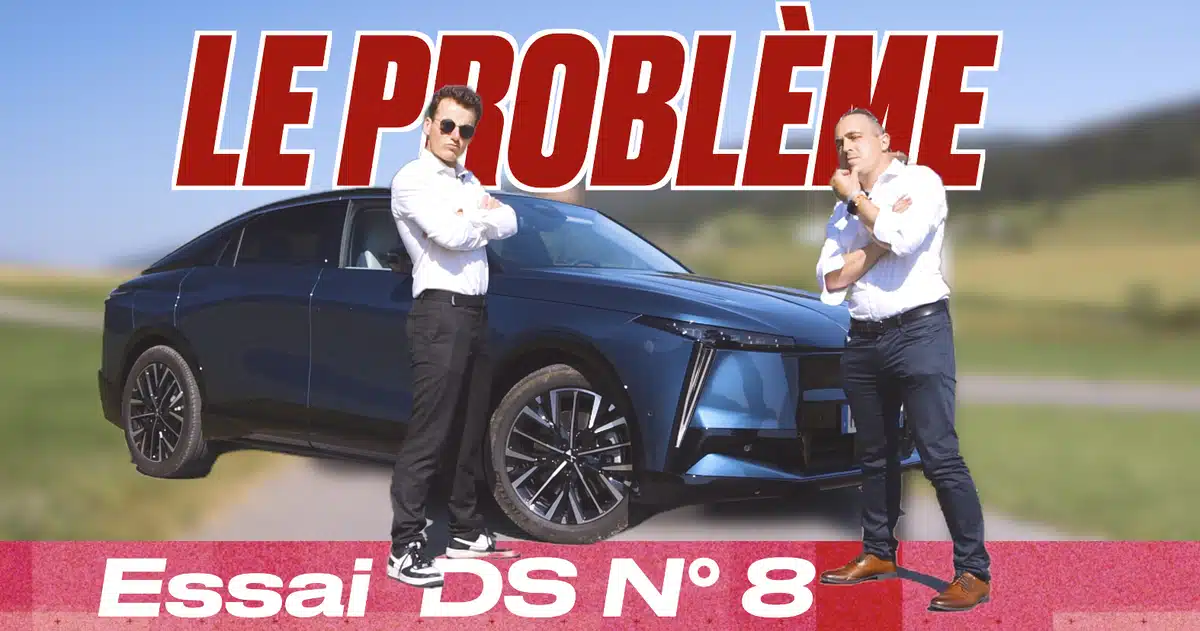
DS, a pair of letters that echo as a symbol of the golden years of French automotive history, synonymous with comfort and innovation.
Amazon co-founder MacKenzie Scott has donated over $19 billion to charity in just five years
Diamond batteries powered by nuclear waste promise 28,000 years of clean energy
With the DS No 8, the burgeoning French brand showcases its high-end ambitions, and even ventures into luxury as one realizes the price tags. But has it strayed from its technological roots? During a test drive in the Swiss Jura, and pending a more thorough review later, it’s time to share our initial thoughts!
Even More Stunning in Person
Initially skeptical about the design from the first images released, the DS No 8 truly impresses in stature when seen on the streets in person.
The dual-tone color scheme complemented by illuminated logos gives it a hint of Rolls-Royce flair, turning heads during our brief test drive. The more understated Pallas version with its monochromatic finish and conservative grille also attracts attention, offering a style that blends more seamlessly into the background.
The sharply chiseled body lines, especially emphasized by the bold vertical lighting, command presence in front of upscale venues like the Divonne-Les-Bains casino.
In reality, the vehicle is cleverly aerodynamic, featuring dynamic flaps under the grille, side vents, a nearly flat rear end with a slight spoiler, and highly optimized wheels, achieving the best Cx (0.24) in the SUV market. This explains why the DS No 8 offers the best range in its class with comparable battery capacity.
Compact and Agile
Another pleasant surprise, the DS No 8 is quite compact, nearly matching the dimensions of a Tesla Model Y.
At just 4.82m long, it compares more closely with vehicles like the Audi Q6, Smart #5, and Polestar 4 than with the larger German sedans (like the EQS, BMW i5…) which are nearly 5m in length.
The No 8 also proves to be quite maneuverable in city driving, thanks to its reasonable width (2.09m including mirrors). It’s easy to get a feel for its size, and it navigates through traffic smoothly, aided by its effective turning radius (11.3m), making it quite agile for everyday use.
NASA warns China could slow Earth’s rotation with one simple move
This dog endured 27 hours of labor and gave birth to a record-breaking number of puppies
Surprisingly, the DS No8 leans more towards a sedan than an SUV, with a ground clearance of just 15cm and a height of 1.58m—lower than a BMW i5. An SUV with the dimensions of a sedan truly turns expectations on their head!
The only drawback is its weight, ranging from 2100 to 2300 kg depending on trim and options. This is 100 to 300 kg heavier than a Model Y, which primarily uses aluminum in its construction.
No Frunk, But a Superb Trunk
The DS No 8 is well-equipped, featuring matrix LED lights from the second trim level, a camera that reads road imperfections, and a full suite of sensors for semi-autonomous driving.
However, the engine bay is packed, leaving no room for a frunk. When asked, the brand feels this small storage area—common in electric vehicles—isn’t really necessary… a sentiment not shared by our team, especially when trying to access charging cables from under the trunk when it’s loaded with luggage!
The rear end rises quite high but does not include a rear wiper. The exceptionally mild weather didn’t allow us to test the vehicle in the rain, but fortunately, a camera films the road and displays it on the digital rearview mirror inside, compensating for this minor flaw.
The trunk opens electronically with a simple foot gesture and boasts a rather generous volume of 620L (1873 L with the rear seats folded down).
If you forego the under-trunk, you gain a lot in height, and it’s also possible to lay large suitcases flat, thanks to excellent length to the back seat. Given its size, these are impressive figures, although Tesla does better with the same external dimensions.
Note that the car can tow up to 1600 kg and carry up to 80kg on roof bars.
Smartphone Key Coming Soon!
In a first for Stellantis, the DS No 8 will be the initial model to offer a smartphone key.
At launch, it will be possible to lock and unlock the vehicle, but you’ll have to wait a few more months to start the car without a physical key. Regarding this, the key offered here seems a bit unworthy of the segment, the same found on entry-level Peugeot or Citroën vehicles… Luxury is also a matter of detail!
Underpowered?
With such prices and a weight exceeding 2 tons, one would expect robust engines.
Unfortunately, apart from the 350 hp AWD (4×4) version, the front-wheel-drive versions are quite modest:
– AWD 350 hp
– 343/509 nm torque
– 0 to 100 Km/h in 7.7/7.8/5.4s
– Max speed 190 Km/h
We only tested the 245 hp version, and the take-off really lacked torque. The acceleration is more vigorous from 50 Km/h onwards, but without the usual electric punch. At this price point, the competition does much better, even the generalist brands like Volkswagen with its superb 286 hp engines in the ID range.
On the winding roads of the Vallée de Joux, we definitely missed extra horsepower for a spirited uphill drive. The vehicle wasn’t struggling compared to a combustion engine car, but for the price, we would have liked at least 300 hp. Conversely, we didn’t notice any traction loss, unlike what we experienced with the Scenic at Renault, or on the rare front-wheel-drive 100% electric vehicles.
The suspensions are adjustable from the second trim level (Etoile), allowing for a bit stiffer damping in sport mode, or to adapt to road imperfections in comfort mode. In practice, the ride is pleasant, but a bit soft overall: body roll is noticeable, even in sport mode, and the body movements may remind some of the queasiness experienced in the DS models of old… and the tires (here EcoContact) tend to squeal a bit too quickly in corners, despite the 20″ wheels. It’s odd not to have air suspension, especially on the 80,000€ version!
Nevertheless, the car clearly focuses on comfort, and with a more relaxed driving style, it’s easy to cover long distances, whether you’re driving or riding as a passenger. The seating is extremely comfortable and supports well regardless of the type of seat (leather or alcantara). Somewhere, the driving philosophy is closer to the original than the more recent DS models, which mimicked Peugeot’s handling.
We didn’t get to try the AWD version, which seems better suited to the size, but it uses the same suspension as its smaller front-wheel-drive sibling. In Switzerland and mountainous areas, customers will likely prefer this version, despite its hefty price tag.
Finally, One-Pedal Driving!
Following Renault, DS has moved to one-pedal driving, and it’s about time!
Accessible via a click on the gear selector, the system can bring the car to a complete stop with maximum regeneration. Initially soft to the touch, it takes some getting used to, although I find it lacks precision in its stages.
For those who prefer the creeping of a combustion engine (an oddity in an EV, but let’s move on), you can still adjust the regeneration via the paddles on three levels. Nevertheless, it’s not possible to be in 100% freewheel mode in the No 8.
Lastly, a word about the braking, which I found a bit squishy at the start of the pedal’s travel and sometimes harsh once it engages the pads. Stellantis still has some work to do on the pedal mapping, which really lacks precision and uniform staging, but then again, this isn’t a sports vehicle.
Camel-like Range
With over 750 Km of range, it simply sets the record for the category with this battery level.
Based on the STA_MEDIUM platform, the DS No 8 benefits from the group’s two batteries:
• 73.7 kWh (net) by BYD (made in China)
The advertised ranges are 550 km for the smaller battery, and respectively 750 and 688 Km for the front-wheel-drive and AWD versions. DS claims it can exceed 500Km on highways with certain models, promising a non-stop Paris-Lyon trip, which we’re eager to test!
During our test, the range fluctuated between 14 (on roads) and 22 kWh (on highways), but these aren’t solid figures before a more extensive test. Nonetheless, Stellantis’ motors are quite efficient, so the real-world range shouldn’t disappoint.
Poor Man’s Recharge
While the range is outstanding, the same can’t be said for charging!
Not having 800V in 2025 on a model priced between 60,000 and 80,000€ is simply baffling. It takes more than 30 minutes to charge the batteries from 10 to 80%, twice the time of recent competitors like the Smart #5, XPeng G6/G9, and others like the Ioniq 6/EV6 from Korea.
• 20-80% in 27 minutes (31 minutes for the smaller battery)
• AC 22 kW
• V2L 3 kW
• Plug&charge
When asked about this, brand officials cite higher costs and questionable benefits given the excellent range. Still, if you need to charge the car quickly for some reason, you’ll need to be patient.
To be fair, models like the Polestar 3/4, BMW i4, Mercedes EQE, and even the Tesla Model Y, don’t really do better, and they’re still on 400V. But these platforms are already a few years old, and 800V is already being planned for the next versions…
It’s worth noting that the charging curve is quite good, allowing you to recover 200Km in 10 minutes. On the other hand, not having high power at the start of charging (like Tesla’s spike to 250 kW) forces you to stay plugged in for a long time on the chargers, even if you don’t want to fully charge. Preconditioning the battery (manually or automatically) should ensure maximum charge even in winter.
DS compensates with an optional AC charge of 22 kW, which cuts charging times from 10 to 5 hours on a suitable station. However, expect about 12 hours for a 7 kW (single-phase) wallbox, commonly found in homes or parking lots.
Lastly, the DS No 8 supports plug&charge (no need for authentication) and V2L (3 kW), which will arrive later.
Interior: Two-Level Luxury
The interiors of DS have always been an invitation to travel, and the DS No 8 is no exception.
The seats are impeccable, both beautiful and comfortable. The manufacturer offers a wide variety of colors and materials. I have a slight preference for the classic bi-tone leather; the blue alcantara version is less slippery but gets quite hot during our tests.
The massages are very pleasant, offering various types of movements. The seats are heated, ventilated, and an unusual neck heater has appeared, though its usefulness is puzzling: the DS No 8 isn’t a convertible, and the function turns off below 20°C. If you’re used to preconditioning the cabin, you’ll never need it…
It should be noted that the rear seats are heated and ventilated from the second trim level, but they are neither massaging nor reclining. In fact, the rear feels a bit outdated for 2025: no screens, no tablets, no chargers in the armrest… Even a Scénic seems more modern in this regard.
The rest