
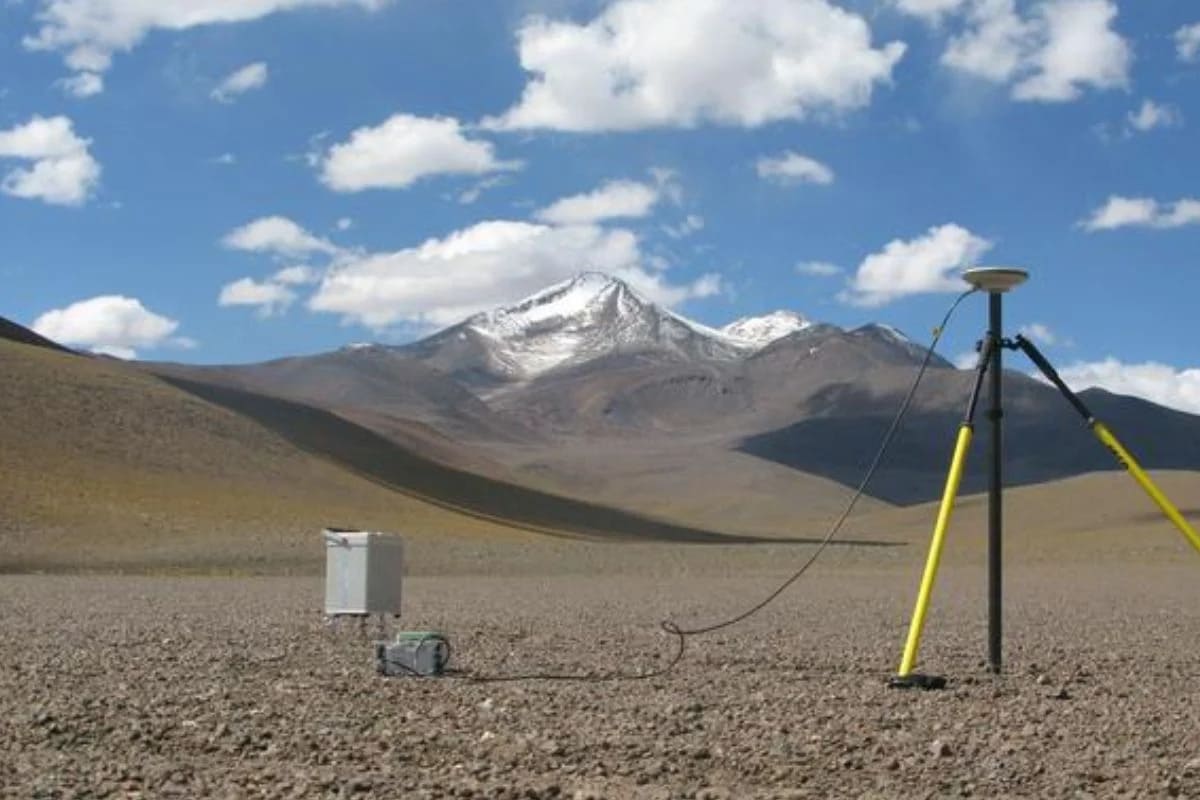
Uturuncu’s recent stirrings remind us that even the planet’s most long-quiet giants can awaken with little warning. Geologists are now racing to decode the subtle signals beneath Bolivia’s dormant shield volcano to gauge the true risk.
Amazon co-founder MacKenzie Scott has donated over $19 billion to charity in just five years
Diamond batteries powered by nuclear waste promise 28,000 years of clean energy
Uturuncu: A Volcano That Refuses to Be Forgotten
I’ll never forget the first time I heard about Uturuncu—the idea of a sleeping giant perched over 6,000 meters high in Bolivia’s Andes seemed the stuff of legends. After lying silent for a quarter-million years, this shield volcano is showing signs of stirring: subtle ground tremors and unexpected gas emissions could signal magma or hydrothermal fluids moving beneath its surface¹. For a volcano so long considered extinct, these whispers of activity are sounding alarm bells across the geologic community.
Unveiling the Volcano’s Secrets: High-Tech Imaging of Uturuncu’s Depths
To peer beneath Uturuncu’s icy cap, scientists mapped over 1,700 seismic events using seismic tomography—a technique akin to a CAT scan for the Earth. The resulting images revealed a curious “sombrero” pattern of deformation: the summit area gently bulging upward while the fringes sink. This unique signature suggests fluids or gases accumulating in shallow reservoirs, slowly warping the crust. It’s a vivid reminder that even dormant volcanoes have hidden dynamics waiting to be understood.
Is an Eruption Imminent?
So, should nearby towns start packing grab bags? Not just yet. While the ground uplift signals internal pressure, there’s no clear sign of magma rushing toward the surface. Researchers believe hot fluids are the main drivers, not large-scale magma ascent, giving communities precious time to plan. Still, volcanologists caution that long-dormant giants can flip from calm to cataclysmic with little warning. Continuous monitoring is essential—today’s inches of uplift could be tomorrow’s volcanic blast.
A Model for Monitoring Inactive Volcanoes
What makes the Uturuncu study truly groundbreaking is its blueprint for surveilling any “inactive” volcano. By merging geophysics, geology, and advanced computer models, scientists can now track subtle signals at hundreds of sites worldwide. This approach could revolutionize early warning systems, shifting the focus from only the obviously restless peaks to those quiet colossi that many had written off as harmless.
Global Collaboration Paves the Way for Future Discoveries
The Uturuncu project wouldn’t exist without an international effort. Teams from Oxford, Cornell, and the University of Science and Technology of China pooled their expertise to decode the seismic data and simulate underground processes. Their partnership underscores how tackling Earth’s greatest mysteries demands crossing borders and disciplines—a model that will become ever more crucial as we confront the planet’s unpredictable forces.
A New Chapter in Understanding “Zombie Volcanoes”
Published in PNAS, these findings introduce us to the realm of “zombie volcanoes”—behemoths that never fully die. Uturuncu shows that dormancy can be a relative term: 250,000 years of quiet doesn’t guarantee eternal peace. By studying these sleepers, geoscientists gain insights into volcanic lifecycles and improve hazards forecasting for communities living in their shadows.
A Global Look at Volcanoes to Watch
While the world watches Uturuncu, other giants like Yellowstone, Kīlauea, and Mount Fuji remind us that volcanic power is never far from our everyday lives. As monitoring techniques evolve, our ability to read the Earth’s subtle tremors improves—hopefully turning today’s discoveries into tomorrow’s lifesaving warnings. In the unpredictable drama of volcanoes, vigilance and collaboration remain our greatest tools.
NASA warns China could slow Earth’s rotation with one simple move
This dog endured 27 hours of labor and gave birth to a record-breaking number of puppies
Footnotes
-
Peltier, A., et al., “Seismicity and Uplift at Uturuncu Volcano,” Proceedings of the National Academy of Sciences, 2024; https://www.pnas.org/doi/10.1073/pnas.2420996122
- National Geophysical Data Center, “Global Volcanism Program – Uturuncu,” 2023; https://www.ngdc.noaa.gov/hazard/volcano.shtml?utm_source=uturuncu