
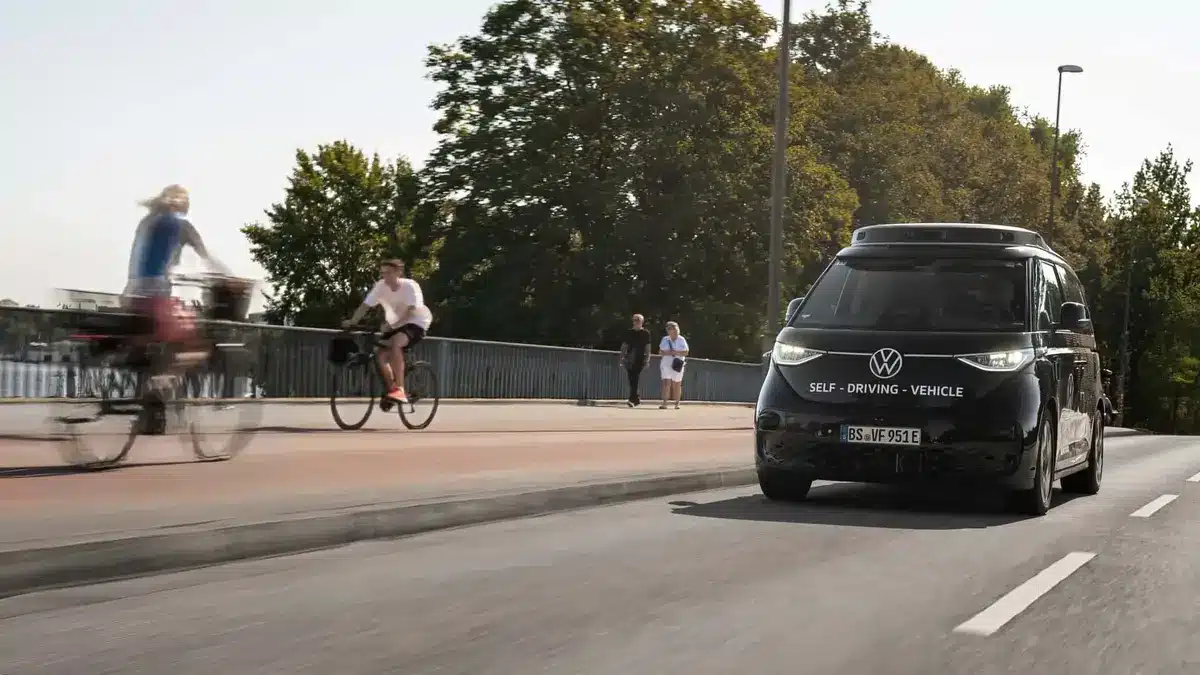
As Tesla gears up to introduce a very limited robotaxi service, Volkswagen unveils its ID. Buzz AD, a fully autonomous driving solution ready for deployment. This announcement highlights the contrast with Elon Musk’s promises.
Amazon co-founder MacKenzie Scott has donated over $19 billion to charity in just five years
Diamond batteries powered by nuclear waste promise 28,000 years of clean energy
Tesla’s “Robotaxi”: A Lot of Hype for Just 10 Cars
The topic has been buzzing for years, and the launch now appears to be just around the corner. Tesla is expected to roll out its robotaxi service by the end of the month in Austin, Texas. It sounds impressive on paper.
However, the reality is that this “launch” is quite symbolic. The fleet will consist of only 10 cars (yes, just ten), which will be restricted to a small area and constantly monitored by teleoperators. We are still far from the revolutionary change that was promised.
Volkswagen and Its ID. Buzz: A “Turnkey” Solution
While Tesla grabs headlines, Volkswagen is making quieter but more substantial progress with a tangible project. Through its mobility subsidiary MOIA, the German company has introduced the production version of its ID. Buzz AD (“Autonomous Driving”).
This isn’t just a vehicle, but a “turnkey” solution aimed at fleet operators. VW provides not only the vehicle but also the entire management software, maintenance, and even operator training. The service is set to launch in Hamburg in 2026 and will expand to other cities thereafter.
A Radically Different Technical Approach
The technical approaches of the two companies also differ significantly. Where Tesla relies solely on cameras, the ID. Buzz AD is a level 4 autonomous vehicle, meaning it can operate without any human intervention within a defined area.
To achieve this, it is equipped with an array of sensors: 13 cameras, 9 LiDARs (laser radars), and 5 traditional radars. The system is controlled by Mobileye, a specialist whose approach is considered by some observers to be safer and more reliable than Tesla’s (which also used Mobileye until July 2016).
What’s the Verdict?
This dual announcement perfectly illustrates the cultural differences between the two companies. On one side, there’s Tesla’s “American showmanship”: grand promises, aggressive marketing, but a launch that’s more akin to a large-scale trial than a true service. On the other, there’s Volkswagen’s “German engineering”: a less flashy but more comprehensive, pragmatic project designed as an industrial solution.
While Musk is selling a dream, VW is selling a product. But let’s not forget a third player: Waymo, Google’s subsidiary, which is already operating thousands of autonomous taxis in several U.S. cities. The race is far from over. Which approach do you trust more: Tesla’s or Volkswagen’s?
NASA warns China could slow Earth’s rotation with one simple move
This dog endured 27 hours of labor and gave birth to a record-breaking number of puppies
If you’re passionate about the future of automobiles, the best way to stay informed is by following our YouTube channel for test drives and analyses!