
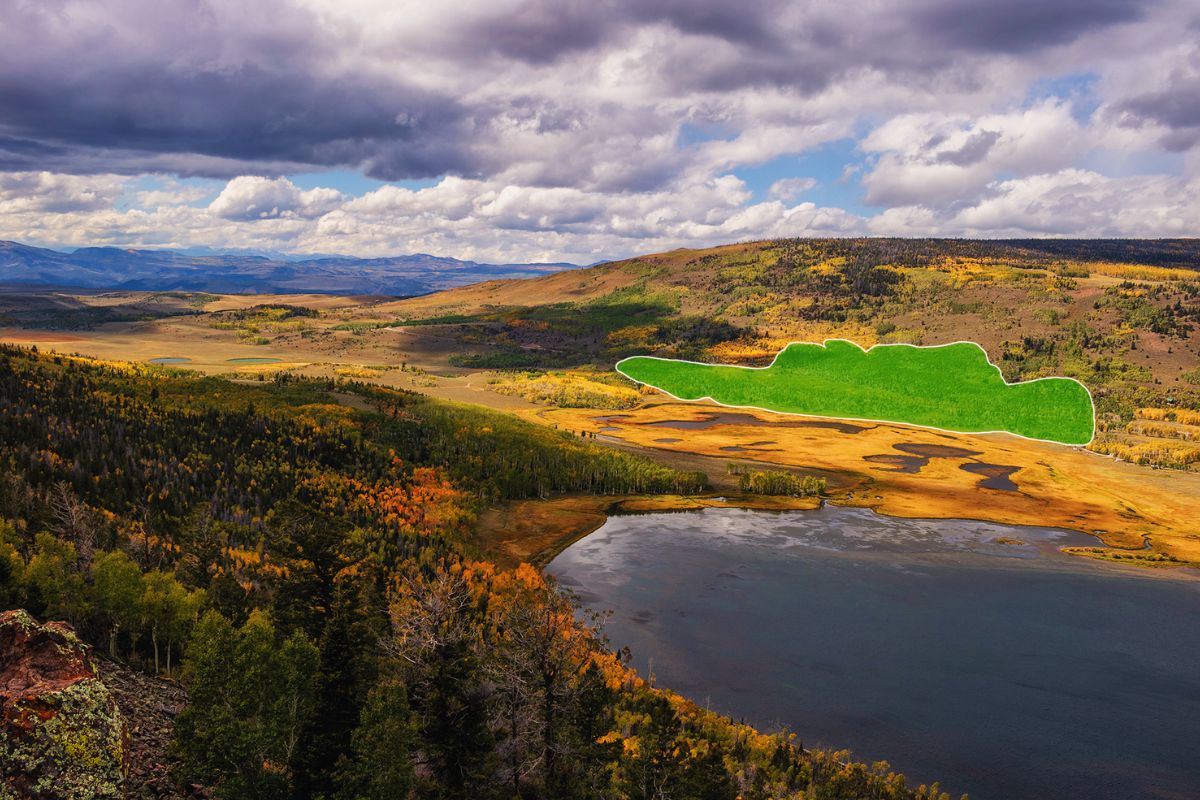
In Utah’s Fishlake National Forest, an ancient giant quietly spans the landscape. Every autumn, its leaves erupt in fiery shades of red, orange, and gold, transforming the forest into a living masterpiece. But Pando, the aspen colony covering over 106 acres (42.6 hectares), is more than a stunning natural wonder—it’s the largest and one of the oldest living organisms on Earth, connected by a single massive root system.
Amazon co-founder MacKenzie Scott has donated over $19 billion to charity in just five years
Diamond batteries powered by nuclear waste promise 28,000 years of clean energy
What Is Pando? A Clone That’s Lived Through Millennia
Pando, Latin for “I spread,” is a quaking aspen colony comprising nearly 50,000 genetically identical trunks. Recent studies estimate its age to be somewhere between 16,000 and 80,000 years. To put that into perspective, even at its youngest estimate, Pando outdates the Great Pyramid of Giza by millennia. This remarkable organism offers scientists a glimpse into the evolutionary processes that have allowed it to thrive through countless environmental changes.
How Pando Grows: A Marvel of Cloning
Pando’s survival hinges on its unique reproductive method. Unlike most trees, it doesn’t rely on seeds for propagation. Instead, it reproduces asexually, producing new trunks as clones of itself through a shared root system. This genetic uniformity, known as triploidy, means that Pando carries three copies of each chromosome, a feature that prevents sexual reproduction and forces it to rely solely on cloning.
But cloning doesn’t mean stagnation. Over millennia, Pando’s cells have accumulated mutations, creating subtle genetic variations across its vast network. These changes are a key area of interest for researchers exploring how cloning impacts long-term survival and adaptability.
The Science Behind Pando’s Genetic Diversity
To better understand Pando’s inner workings, scientists recently collected samples from its roots, bark, leaves, and branches, comparing them with other aspen colonies. They identified 4,000 genetic variants that have emerged during its long history. Surprisingly, the findings revealed that while trees close to one another share more genetic similarities, these differences are less pronounced than expected, even across Pando’s sprawling system.
William Ratcliff, a co-author of the study, noted that Pando’s genetic information seems surprisingly well-distributed, challenging assumptions about how mutations spread in clonal organisms.
What Makes Pando So Resilient ?
One theory is that Pando’s triploidy could play a significant role in its incredible longevity. This genetic trait is thought to produce larger, more robust cells and make the organism more adaptable to environmental shifts. These factors might explain why Pando has endured for thousands of years while other ecosystems have risen and fallen around it.
Moreover, Pando’s structure—thousands of interconnected trunks rather than a single, centralized organism—could make it inherently resistant to localized threats like disease or environmental stress.
A Living Testament to Nature’s Resilience
Pando is not only a biological wonder but also a reminder of nature’s extraordinary ability to endure. With its shared root system, adaptability, and genetic complexity, it stands as a testament to the resilience of life in the face of time and change.
NASA warns China could slow Earth’s rotation with one simple move
This dog endured 27 hours of labor and gave birth to a record-breaking number of puppies
As researchers continue to uncover its secrets, Pando provides valuable insights into clonal evolution, genetic diversity, and ecological sustainability. It’s a living time capsule, connecting us to the distant past while inspiring hope for the future of conservation and natural preservation.