

A 13-year-old Canadian student has brought a centuries-old legend to life by creating a miniature version of Archimedes’ death ray for a school project. What started as a classroom experiment has captured the imagination of many, as the young inventor demonstrated how ancient principles could still inspire modern-day science.
Amazon co-founder MacKenzie Scott has donated over $19 billion to charity in just five years
Diamond batteries powered by nuclear waste promise 28,000 years of clean energy
Recreating Archimedes’ Legendary “Death Ray”
The concept of the “death ray” dates back over 2,000 years to ancient Greece, where the brilliant mathematician and inventor Archimedes was believed to have used mirrors to focus sunlight onto enemy ships. The goal? To set those ships ablaze and defend the city of Syracuse from a Roman invasion. According to historical accounts, Archimedes positioned multiple mirrors to reflect sunlight onto a single target, concentrating the heat to the point of combustion. While its effectiveness has been debated by scholars, the idea has captivated minds for centuries.
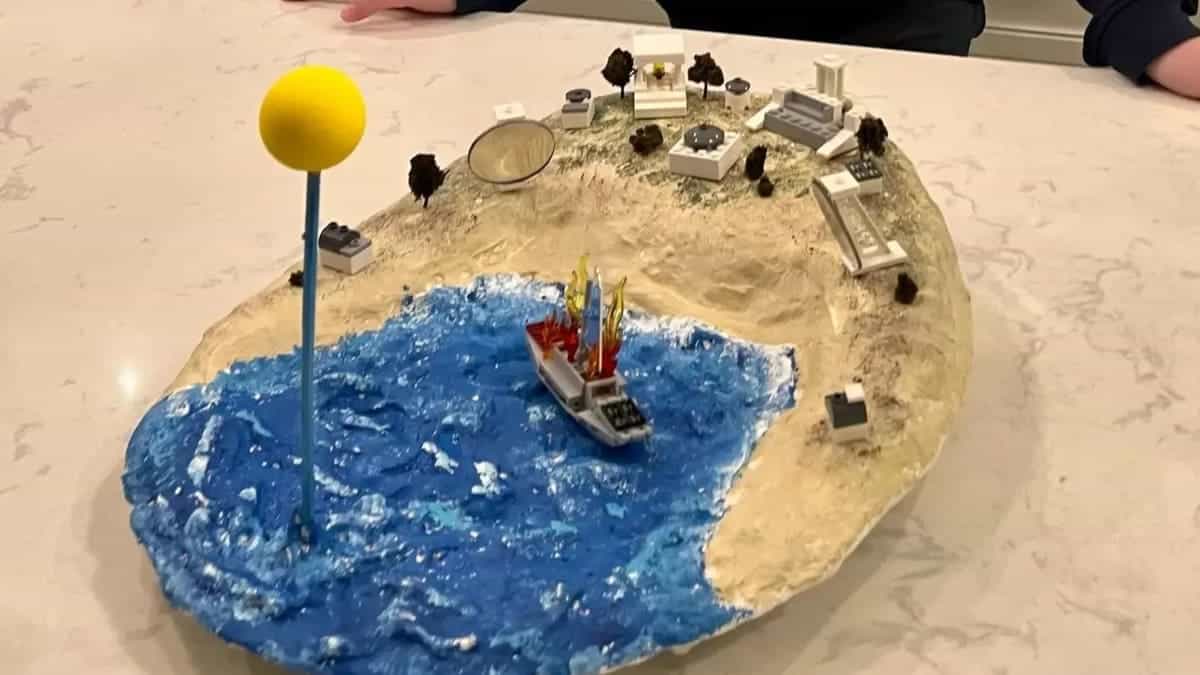
Fast forward to today, and Brenden Stener, a young student from Canada, has created his own version of this infamous ray. His school project aimed to replicate Archimedes’ concept in a manageable, smaller-scale experiment. Brenden explained, “It’s just a smaller version, as close as possible to the real thing,” he told Business Insider. His curiosity about Archimedes’ inventions led him to research extensively, fueling his fascination with the ancient scientist’s work.
How the Miniature Death Ray Works
Brenden’s creation involved using heating lamps to act as a stand-in for the Sun. He then positioned concave mirrors to reflect the light from one mirror to another, ultimately directing it at a target marked with an “X.” The results were impressive. Using an infrared thermometer, Brenden measured the temperature of the target and found it to increase dramatically with each mirror added. At its peak, the temperature of the target rose to over 50 degrees Celsius.
“It’s really possible to increase the scale and, with a powerful enough heat source, ignite the target,” Brenden noted. His miniature death ray demonstrated that the principle of focusing light onto a small area to generate heat could still work in a modern context, even if the scale needed to ignite large objects like ships would be far more complex.

The Real Challenge: Scaling Up the Concept
While Brenden’s success is an impressive example of scientific curiosity and practical application, it’s important to note that replicating the legendary feat on a large scale would be much more difficult. As Brenden himself pointed out, setting ships on fire in the middle of the sea—especially moving ships—would require far more than just a handful of mirrors and lamps. The complexity of such an operation, with the dynamic nature of weather, distance, and the moving target, would make it incredibly challenging.
NASA warns China could slow Earth’s rotation with one simple move
This dog endured 27 hours of labor and gave birth to a record-breaking number of puppies
Nevertheless, Brenden’s project garnered significant attention. His work was recognized by the London Public Library, where he was awarded a scientific prize for his innovative experiment. His ability to bring ancient history into the modern age with a classroom project serves as a powerful reminder of how timeless ideas can inspire the next generation of inventors.
This project not only sparked interest in Archimedes’ ancient inventions but also highlighted the power of creative problem-solving and curiosity in young minds. While Brenden’s miniature death ray might not be the weapon of ancient legend, it proves that innovation, no matter the scale, starts with a single spark of inspiration.