
In a breakthrough that challenges our understanding of atomic structure, a team of international researchers has successfully created a six-neutron hydrogen isotope—something that was once thought to be purely theoretical. This incredible achievement was made possible using an electron beam and a high-powered particle accelerator. The result offers new insights into the fundamental forces that govern the universe, and may even reshape the way we think about the interactions of neutrons and protons.
Amazon co-founder MacKenzie Scott has donated over $19 billion to charity in just five years
Diamond batteries powered by nuclear waste promise 28,000 years of clean energy
The World’s Most Unstable Hydrogen Atom
For decades, the basic hydrogen atom was defined as having just one proton and one electron, a simple and stable configuration. We also know of the triton, a form of hydrogen with two neutrons. However, the idea of hydrogen with five neutrons was considered practically impossible. Enter the groundbreaking discovery of ⁶H, a hydrogen isotope with one proton and six neutrons, created for the first time in history.
This particular isotope is the most unstable hydrogen atom ever observed. Its neutron-to-proton ratio is the highest of any known element, making it a record-breaker in the world of atomic science. This discovery isn’t just a technical feat—it challenges long-standing models of how neutrons and protons interact at the nuclear level. Scientists are now faced with the question: how many neutrons can be packed around a single proton before the atom collapses?
Did you know? The creation of such exotic isotopes is a rare occurrence in nuclear science. The discovery of ⁶H has potential applications beyond basic research, possibly influencing nuclear energy and astrophysics.
A Two-Step Process with Precision and Care
The creation of ⁶H wasn’t a simple task. The researchers used a lithium-7 target, which is naturally rich in neutrons. The process unfolded in two steps:
-
An electron beam with an energy of 855 MeV bombarded the lithium-7 target, causing one of its protons to transform into a neutron, releasing a pion in the process.
-
This newly created neutron transferred energy to a second proton. In a rare occurrence, this interaction led to the formation of the ⁶H nucleus, while the pion and proton escaped the nucleus.
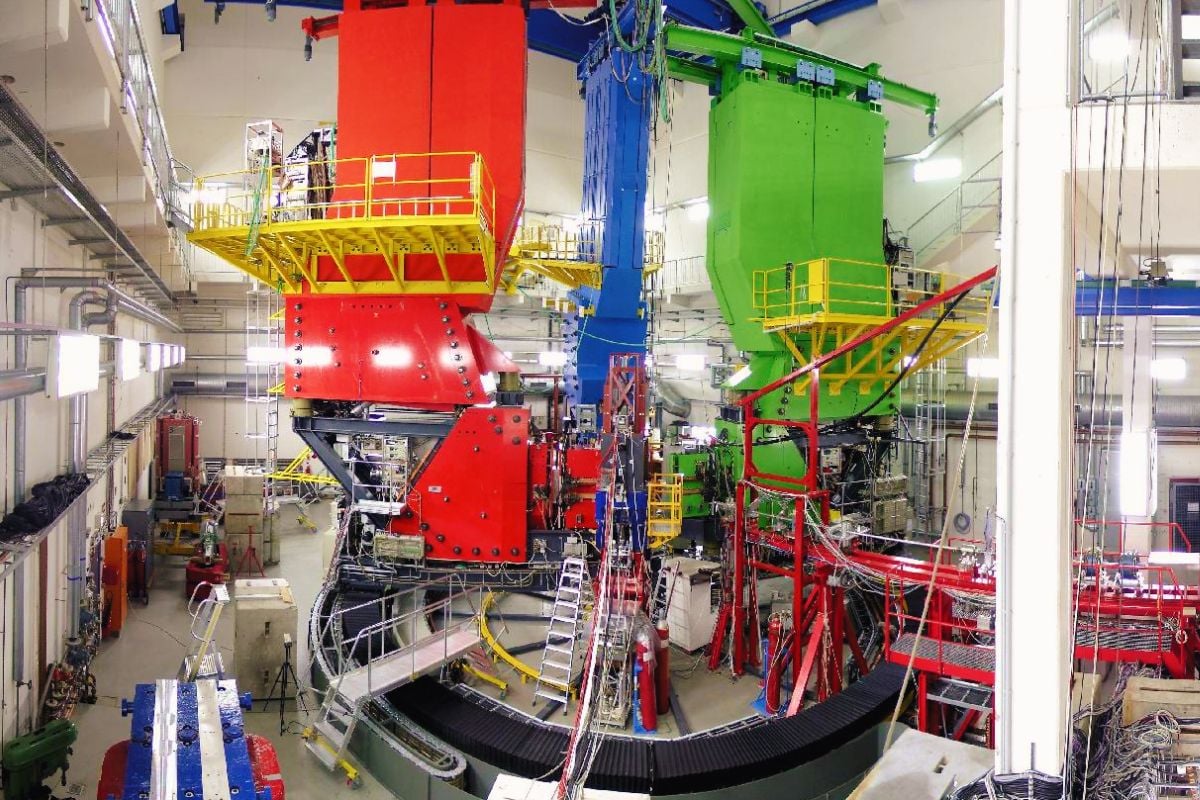
This chain of events was carefully tracked using three magnetic spectrometers, which allowed the team to measure the scattered electron, the pion, and the proton all at once. This triple confirmation was crucial for validating the existence of this highly unstable isotope.¹
A Rare Event, But It Worked
Creating such a rare isotope is no easy task. The researchers observed the formation of ⁶H only once per day over the span of four weeks. While that may seem like a slow pace, the data was clear: the isotope had been successfully produced. And, surprisingly, its rest mass was lower than the models had predicted.
This unexpected result suggests that neutrons interact with each other more strongly than scientists had anticipated in this kind of atomic structure. This new understanding could provide important insights into the forces at play inside neutron stars or during supernova explosions—environments rich in neutrons that are critical to our understanding of astrophysical phenomena.²
Did you know? Neutron stars, which are remnants of massive stars that have exploded in supernovae, are made almost entirely of neutrons. Their extreme density makes them natural laboratories for studying neutron interactions.
NASA warns China could slow Earth’s rotation with one simple move
This dog endured 27 hours of labor and gave birth to a record-breaking number of puppies
Delicate Materials and a Precision Setup
The creation of ⁶H required more than just a high-powered electron beam and sophisticated detectors—it also depended on a highly delicate lithium-7 target. The team stretched the lithium into a thin band, 45 mm long and only 0.75 mm thick. This unconventional geometry was crucial to maximize the chances of electron interactions.
However, working with lithium is no easy feat. It’s a reactive metal that is unstable when exposed to air, requiring meticulous handling to ensure the material’s integrity throughout the experiment. The scientists had to take great care in maintaining the lithium’s stability during the testing process.
Did you know? Lithium, the lightest metal, is used in various technologies, including rechargeable batteries and certain medical treatments, but it’s highly sensitive to moisture and oxygen, making it challenging to work with in laboratory settings.
MAMI: The Powerhouse Behind the Discovery
None of this would have been possible without the Mainz Microtron (MAMI), an advanced electron accelerator at the heart of the experiment. MAMI generates a highly stable, precise electron beam, with minimal background noise, making it ideal for experiments in fundamental physics. Combined with the spectrometers from the A1 Collaboration, this tool enabled the team to study exotic nuclear structures with exceptional precision.
The result of this collaboration was the ability to measure an ephemeral, invisible phenomenon, turning what was once purely theoretical into something tangible. This achievement marks a significant milestone in the study of atomic particles, with implications for both nuclear physics and our broader understanding of the universe.³
Footnotes:
-
“Production of the neutron-rich nucleus 6H in an electron-scattering experiment at MAMI-A1” Science Direct. https://www.sciencedirect.com/science/article/abs/pii/S0375947425001824
-
“Neutron Stars and Their Extreme Density” Astrophysical Journal. https://iopscience.iop.org/journal/0004-637X
-
“The Mainz Microtron (MAMI)” University of Mainz. https://www.blogs.uni-mainz.de/fb08-nuclear-physics/accelerators-mami-mesa/the-mainz-microtron/