
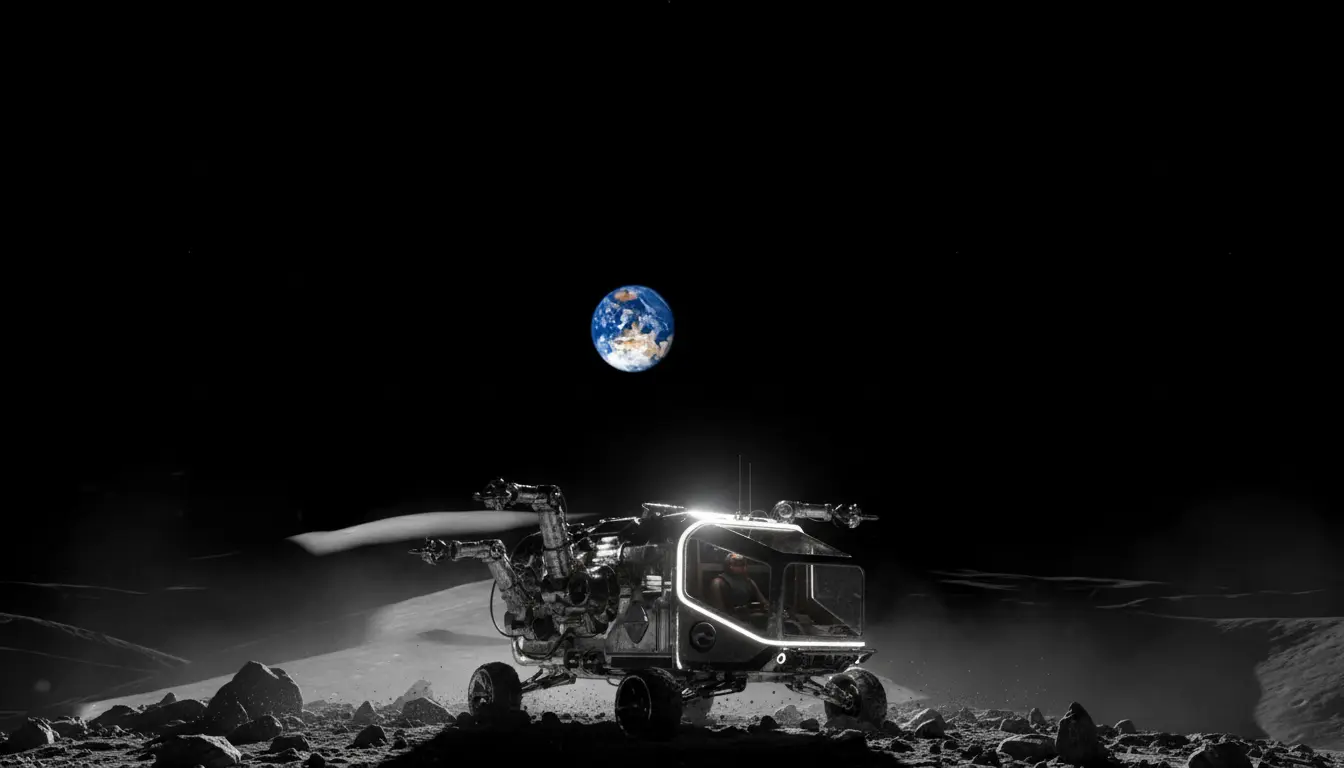
If you ever find yourself standing on the Moon’s south pole (helmet on, of course), get ready to have your mind—and your sense of direction—thoroughly scrambled. From this unique spot, Earth floats above the horizon, not quite as you know it: it appears upside down, spins backward, and puts on a cosmic ballet that’s as mesmerizing as it is topsy-turvy. Intrigued? Let’s take a lunar leap into this unusual perspective, based on a NASA visualization that lets us peek at our home planet in a whole new light.
Amazon co-founder MacKenzie Scott has donated over $19 billion to charity in just five years
Diamond batteries powered by nuclear waste promise 28,000 years of clean energy
Earth from the Moon: A View Reserved for a Lucky Few
- Very few humans have ever truly looked back at Earth from the lunar surface.
- From the Moon, especially from the south pole, Earth itself displays phases—just like the Moon does from our vantage point.
- A NASA animation released on October 16, 2021, reveals the peculiar motion of Earth as seen from the Moon’s southernmost tip.
A Dance of Shadows and Light: What the NASA Animation Shows
The animation, created and narrated by Ernie Wright from NASA’s Goddard Space Flight Center, goes beyond pretty pictures. It invites us to imagine how shadows evolve over time, courtesy of the Sun’s ever-shifting light cast on both Earth and the Moon. As Wright succinctly puts it, “things don’t set and rise in the usual way here.”
In other words, while we’re used to the Sun gently arcing across our sky, lunar south pole observers would notice the Sun gliding around the horizon in an extended, sweeping circle, keeping those massive lunar shadows in place. No mundane sunrises or sunsets here—just an endless, slow-motion light show.
Why Does Earth Look Upside Down and Spin Backward?
This is where things get truly mind-bending. As Ernie Wright explains, Earth appears upside down and rotates backward from the Moon’s south pole. But don’t worry, you haven’t quantum-leapt into a parallel universe—it’s simply a matter of perspective.
- The apparent inversion and backward rotation are optical illusions, caused by the observer’s unique point of view from the Moon’s south pole.
- Earth hardly budges in the lunar sky. Instead of gracefully drifting from one horizon to another, it hangs almost in place above the surface, always over roughly the same spot.
- This isn’t just a quirk of the lunar south pole. The effect is the same anywhere on the Moon’s near side—the half that perpetually faces Earth.
So, if you ever get lost moon-walking, don’t rely on sunrise or sunset, and certainly don’t expect Earth to parade across the heavens!
Eclipses and Eternal Shadows: The Rhythms of the Lunar South Pole
Let’s talk about solar motion and eclipses. On the Moon’s south pole, the Sun takes about a month to complete its stately journey around the horizon. From time to time, the Sun will slip behind Earth, plunging the area into a momentary eclipse. According to Wright, this looks quite different from the solar and lunar eclipses we’re used to seeing from Earth. In the visualization, this moment has been slowed down about a minute in, for your awe and convenience.
- On Earth, this event is a total lunar eclipse.
- On the Moon, it’s a solar eclipse, but with an Earth-sized twist.
The animation doesn’t just stop at the sky. It also shows the real conditions of the Moon’s south pole: a landscape riddled with craters. Shackleton Crater, featured in the foreground, is a standout, its interior shrouded in perpetual darkness—talk about moody lighting! To achieve this realistic depiction, Ernie Wright relied on images from the Lunar Reconnaissance Orbiter, which has been diligently observing the Moon’s surface since 2009.
Final thought: While most of us are unlikely to take a stroll beside Shackleton Crater any time soon, NASA’s animation offers a tantalizing glimpse of the cosmic choreography that unfolds under alien skies. Next time you gaze at the Moon, try to imagine Earth—large, blue, and upside down—smiling back, caught in its own strange lunar waltz. Sometimes, all it takes is a change of perspective to remind us how marvelous (and a little bit weird) our universe can be.