
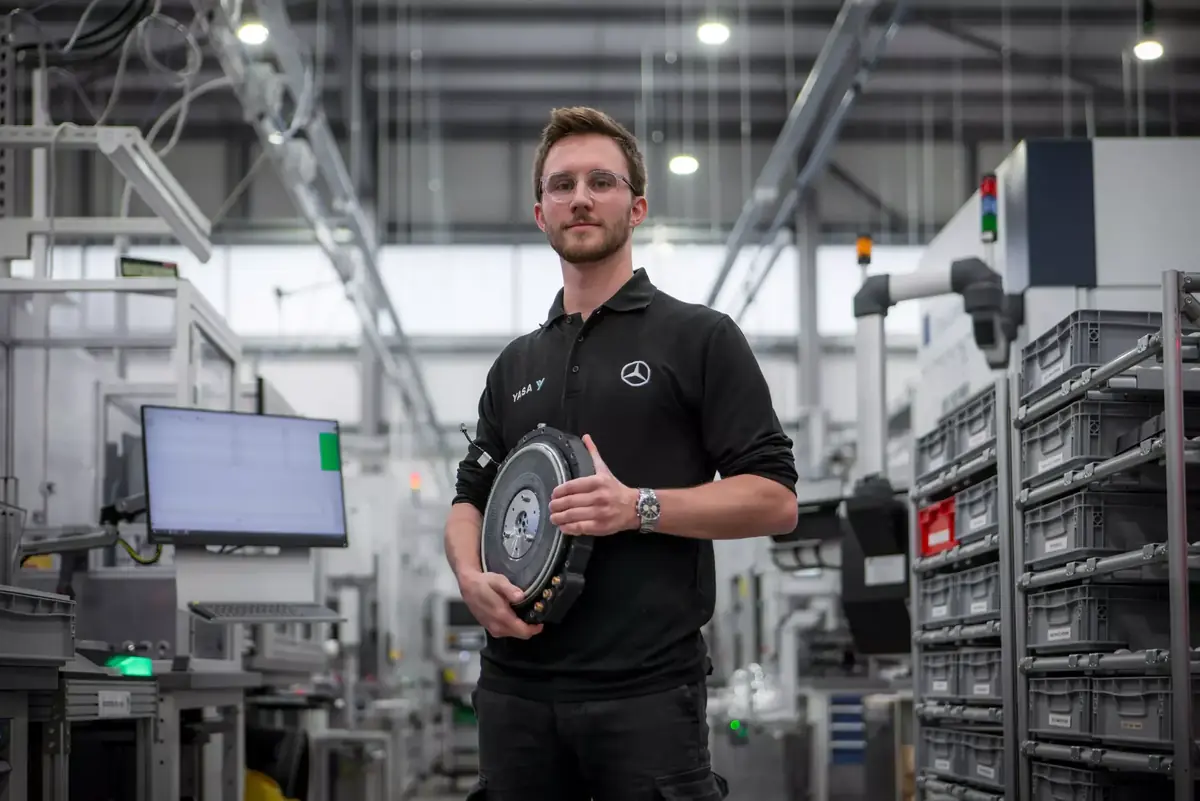
YASA, a subsidiary of Mercedes-Benz, has just shattered its own record with its new axial flux electric motor. Weighing in at just 12.7 kg (about the weight of a lightweight bicycle), it delivers a staggering 750 kW, which is over 1000 horsepower. This marks a significant step forward for lighter and more powerful electric vehicles.
Amazon co-founder MacKenzie Scott has donated over $19 billion to charity in just five years
Diamond batteries powered by nuclear waste promise 28,000 years of clean energy
A Thousand Horses in the Weight of a Bike
To put things into perspective, YASA’s prior prototype boasted 550 kW (738 hp) at a weight of 13.1 kg. The latest iteration significantly improves on this by reducing the weight to 12.7 kg while achieving a peak power output of 750 kW (over 1000 hp) during testing. This represents a 40% increase. The key metric here is “power density,” which refers to the amount of power produced per kilogram. We now have an (unofficial) record of 59 kW/kg. To give you an idea, that’s more power than two combined Tesla Model 3 Performances in a package small enough to nearly hold in one hand.
The Secret: Axial Flux Technology
It’s not just the peak power, which is achieved in short bursts, that impresses. YASA estimates this prototype can deliver a continuous power (the output it can sustain without overheating) of between 350 and 400 kW (469 to 536 hp), which is still substantial. The secret lies in the axial flux technology. Unlike most current electric motors that use “radial flux,” the YASA motor is flatter, disc-shaped. This design allows it to generate far more torque and power relative to its mass. According to YASA’s CEO, this approach achieves a performance density three times higher than the best radial motors.
Coming to Our Cars Soon?
YASA emphasizes that this is not just a computer simulation. Tim Woolmer, the company’s founder, clarified: It’s running right now on test benches
. Importantly, this motor is designed for mass production. It doesn’t use any exotic materials and relies on manufacturing processes that are widely used.
This technology is already in use in hybrid supercars like the Ferrari 296 GTB. This groundbreaking motor is clearly intended for future high-performance models from Mercedes-AMG.
So, why isn’t this miraculous motor already in all our cars? The answer involves three factors: cost, complexity, and heat. First, traditional motors (radial flux) have been mass-produced for over a century, making them very cost-effective to manufacture. Additionally, the pancake-like design of the axial flux motor requires extreme manufacturing precision to manage the alignment of the discs and the immense magnetic forces trying to “stick” them together.
Lastly, packing 1000 hp into such a compact volume generates intense heat, and this “sandwich” structure is particularly challenging to cool effectively. For now, these challenges limit this technology to high-performance applications, such as supercars, where cost is a secondary concern.
What’s the Verdict?
The primary adversary of electric vehicles is weight. Heavy batteries require heavy structures, which in turn necessitate even larger batteries to maintain range. It’s a vicious cycle.
YASA’s achievement with this motor offers an intriguing possibility to break this cycle. A motor that is both lightweight and powerful allows for significant reductions in vehicle weight. This paves the way for using smaller (thus lighter and quicker to recharge) batteries while maintaining comparable range. This is Mercedes-Benz’s secret weapon for its future platforms. If this technology eventually trickles down to more mainstream models, it could indeed be a game-changer.