
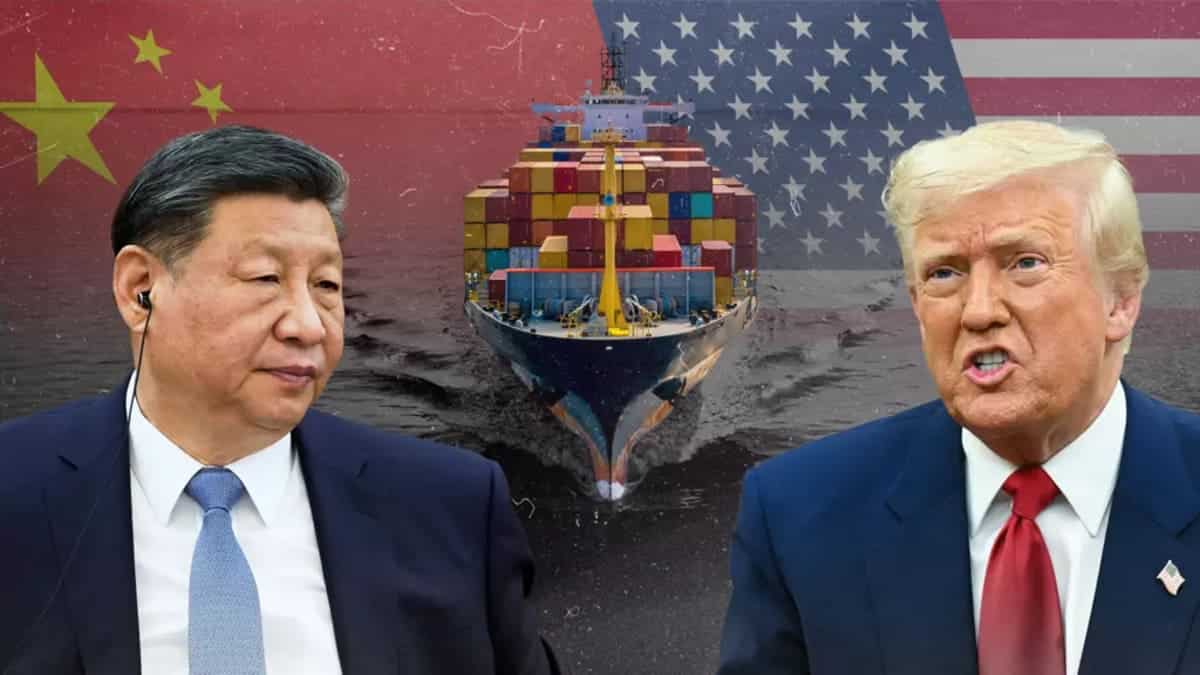
The rising tensions between China and the United States in recent years have a familiar ring to them—reminiscent of the trade war that began in 2018 during Donald Trump’s first presidency. The two nations have once again found themselves locking horns over tariffs, with the U.S. announcing sweeping new barriers on imports. However, this time the situation is different in several significant ways, and it appears that China is better equipped to handle the standoff.
Amazon co-founder MacKenzie Scott has donated over $19 billion to charity in just five years
Diamond batteries powered by nuclear waste promise 28,000 years of clean energy
Musk’s Vision for Mars Colonization
The ongoing tariff escalation between the U.S. and China bears some resemblance to the trade war of 2018, when the two superpowers exchanged tariffs in a tit-for-tat fashion. Back then, Trump initiated tariffs on Chinese imports, which were met with immediate retaliation from Beijing. In a move that caught Trump off guard, China quickly matched the U.S. tariffs, leading to an intense back-and-forth that threatened global trade stability. Fast forward to today, and while the rhetoric is familiar, the landscape has changed in several key ways.
China’s Economic Resilience
In 2018, China was relatively more vulnerable in the face of U.S. tariffs. At the time, the country had an economy growing at an impressive rate, but the global downturn in the following years—coupled with a sharp slowdown in growth—revealed weaknesses. Today, however, China has taken significant steps to fortify its economic structure, distancing itself from its reliance on the U.S. market. As of 2024, Chinese exports to the U.S. account for about 14% of total exports, down from nearly 20% in 2018. In addition, trade with emerging markets has gained more importance than ever, surpassing traditional G7 nations.
Economists such as Johannes Petry, an expert on Chinese financial markets at Goethe University, point out that while China’s economy is facing challenges, its response to these pressures has been notably different from 2018. The Chinese government has a broader toolkit of fiscal and monetary policies at its disposal to cushion the impact of the trade war, which gives China a significant advantage. Petry notes, “The Chinese government still has considerable leeway to support its economy, unlike the U.S., which faces a widening budget deficit and limited options in the event of a recession.”
Trump’s Stronger Hand, China’s Strategic Response
One major difference this time around is the shift in U.S. leadership. In 2018, Trump faced internal resistance within his own administration from officials who were wary of going too far with trade measures. Figures like John Kelly and H.R. McMaster served as moderating voices, tempering Trump’s more extreme impulses. However, with a more unified stance in his second term—and in the context of his growing political support—Trump now has fewer checks on his trade policies. This shift has allowed him to apply a more aggressive “madman” strategy, aiming to destabilize opponents by making them believe he is willing to take extreme actions.
China, on the other hand, is no longer caught off guard by Trump’s actions. After Joe Biden’s victory in 2020, Beijing quickly realized that the U.S. would continue enforcing many of the tariffs initiated by the Trump administration. This realization prompted China to rethink its economic strategy, focusing on diversifying its trade partnerships and reducing dependence on the U.S. market.
China’s Strategic Trade Diversification
Today, China’s trade networks are more diversified than ever. While exports to the U.S. have dropped, trade with countries like those in Africa, Latin America, and Asia has grown. These emerging markets now represent a more significant share of Chinese exports. As Xin Sun, an expert on Chinese economics at King’s College London, points out, “In recent years, Chinese trade with emerging economies has become more important than trade with the G7 countries.”
The diversification of trade is not just a defensive maneuver but a strategic shift that has allowed China to reduce the impact of U.S. tariffs. Furthermore, Beijing’s growing influence in global trade has given it more leverage in negotiations, meaning it can weather the trade storm more effectively than in 2018.
NASA warns China could slow Earth’s rotation with one simple move
This dog endured 27 hours of labor and gave birth to a record-breaking number of puppies
More Tools at China’s Disposal
Unlike 2018, when China had fewer options to mitigate the damage of the trade war, the country now has more tools at its disposal. Fiscal and monetary policy options remain open to the Chinese government, and Beijing can afford to support key industries if needed. Meanwhile, the U.S. is facing a growing budget deficit and more limited space to maneuver economically. As Petry observes, “The Chinese government has more room to respond, while the U.S. may find itself boxed in, especially in the event of a downturn.”
Furthermore, China is beginning to use its economic power more aggressively. For example, China has started to place restrictions on key materials like rare earth elements, which are crucial for tech industries, including electric vehicles and consumer electronics. The U.S. imports 80% of its rare earths from China, giving Beijing considerable leverage in this area. As Xin Sun points out, “China has begun to use rare earths as a tool to apply pressure without firing the first shot in the trade war.”
The Escalation and What Lies Ahead
While the trade war rhetoric may have intensified, China is now in a stronger position than it was in 2018. Despite the U.S. applying tariffs on Chinese imports and targeting nations like Vietnam, Mexico, and others that were acting as intermediaries for Chinese goods, China’s strategy of trade diversification and economic preparation has given it the upper hand. Should the U.S. decide to escalate further, China has more options to respond.
The real test will be how other countries respond. If the U.S. successfully pressures its allies to join the economic blockade against China, it could worsen Beijing’s situation. However, if China can avoid these pressures, it will be better positioned to weather the storm. Marc Lanteigne, a professor of Sinology at the University of Tromsø, sums up the situation well: “China has learned from the past, and it knows it can’t afford to appear weak this time around.”
In conclusion, while the current trade tensions between the U.S. and China may echo those from 2018, the landscape is markedly different. China is more resilient, better prepared, and has a stronger set of economic tools at its disposal. As these tensions evolve, the world will be watching to see how both superpowers navigate this complex and high-stakes battle.