
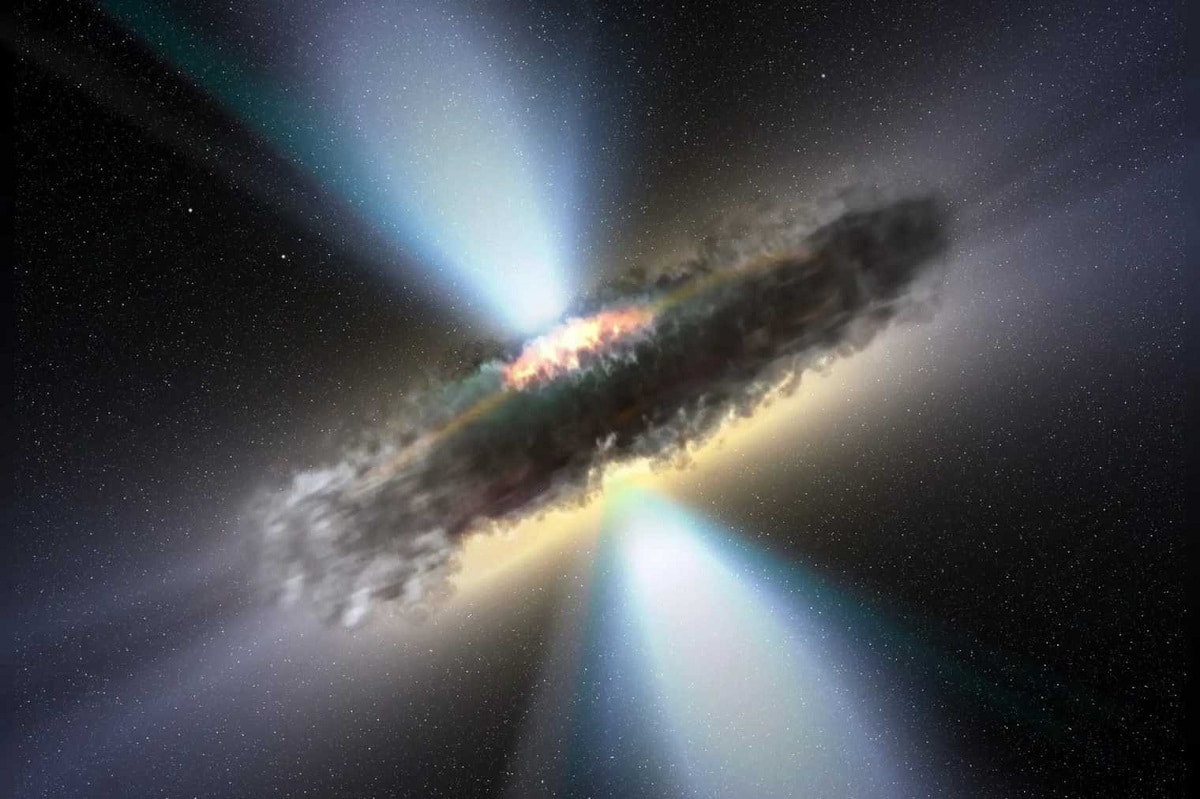
In a discovery that seems almost too fantastical to believe, astronomers recently unveiled a colossal water reservoir in space—one that contains a staggering 140,000 trillion times the amount of water on Earth. This immense cosmic body of water, located a remarkable 12 billion light-years away, has forced scientists to reimagine the universe’s water cycle and consider the broader implications for life beyond Earth.
Amazon co-founder MacKenzie Scott has donated over $19 billion to charity in just five years
Diamond batteries powered by nuclear waste promise 28,000 years of clean energy
A Colossal Quasar at the Heart of the Discovery
The source of this extraordinary discovery is a quasar known as APM 08279+5255. Situated so far from our planet that it’s almost impossible to grasp, this quasar is home to a supermassive black hole with a mass 20 billion times that of our Sun. To help put things into perspective, the energy emitted by this quasar is equivalent to the combined output of a thousand trillion Suns. But what really caught the attention of researchers was the sheer volume of water surrounding this quasar: 140 trillion times the volume of Earth’s oceans.
As Matt Bradford, a researcher at NASA’s Jet Propulsion Laboratory, explained in a study published in the Astrophysical Journal Letters, the environment around this quasar is truly one of a kind. “The medium around this quasar is truly unique in its ability to produce this massive amount of water,” Bradford noted. This discovery underscores an intriguing aspect of the universe: water, a resource so familiar to us on Earth, is far more abundant across the cosmos than we ever thought.
A Galactic Oasis with Surprising Properties
Not only is this water reservoir vast, but it also has some very surprising properties. For instance, the temperature of the water vapor surrounding the quasar is a chilling -63°C, far colder than the average temperatures found in other galactic environments. In fact, it’s about five times warmer than what is typically observed in similar regions of space. Additionally, the density of the water vapor in this area is between 10 to 100 times denser than what scientists usually expect in such environments.
These unusual conditions are the result of the intense X-ray and infrared radiation emitted by the quasar, which causes the gases around it to behave in ways that are unlike anything found on Earth. Scientists speculate that this enormous water reservoir may actually serve as a fuel source for the black hole, helping it to potentially grow to six times its current size. It’s yet another reminder that the universe is full of extreme environments where water—a substance we take for granted—is capable of existing in forms we never expected.
Water, a Universal Element
This discovery is just one of many that shows how widespread water is across the universe. In fact, water is not just confined to the quasar APM 08279+5255. Scientists have found it in a variety of other places, including:
- Interstellar clouds: For example, in the Orion Nebula, located 1,344 light-years away, scientists have detected both water vapor and ice.
- Protoplanetary disks: Around the star PDS 70, located 370 light-years away, water vapor has been found in large quantities.
- Comets and asteroids: Celestial bodies like comet 67P/Churyumov-Gerasimenko contain significant amounts of frozen water.
- Exoplanets: The exoplanet K2-18b, located 124 light-years away, has been found to have water vapor in its atmosphere.
These findings highlight a crucial point: water, whether in vapor, ice, or liquid form, is not a rarity in the cosmos. From the farthest reaches of galaxies to young planetary systems still in the process of forming, water is a constant presence. This suggests that the building blocks for life may be far more widespread than we ever thought.
A Springboard for Future Discoveries
The discovery of this enormous water reservoir near APM 08279+5255 marks a significant milestone in our efforts to understand the role of water in the universe. It opens up new lines of inquiry, especially regarding how water may have contributed to the formation of galaxies, stars, and even life. As astronomers continue to study these far-off regions, they may uncover more secrets about the origins of water and its crucial role in the evolution of the cosmos.
NASA warns China could slow Earth’s rotation with one simple move
This dog endured 27 hours of labor and gave birth to a record-breaking number of puppies
Looking ahead, future space missions and observations from Earth will no doubt continue to explore these remarkable galactic oases. As we look deeper into the mysteries of space, one thing is clear: water is far from a rare commodity in the universe. In fact, it’s an essential and pervasive element that challenges us to reconsider not just our place on Earth but our role in a universe that is wetter than we ever imagined.