
In a world where advanced mathematics often feels like a modern invention, it’s truly awe-inspiring to realize that ancient civilizations were already exploring complex mathematical principles. A recent discovery in the field of archaeology has revealed that the Babylonians were using geometrical techniques that predate even the famous Greek mathematician Pythagoras, shedding new light on the sophistication of ancient mathematics.
Amazon co-founder MacKenzie Scott has donated over $19 billion to charity in just five years
Diamond batteries powered by nuclear waste promise 28,000 years of clean energy
A 3,700-Year-Old Tablet with Ancient Geometry
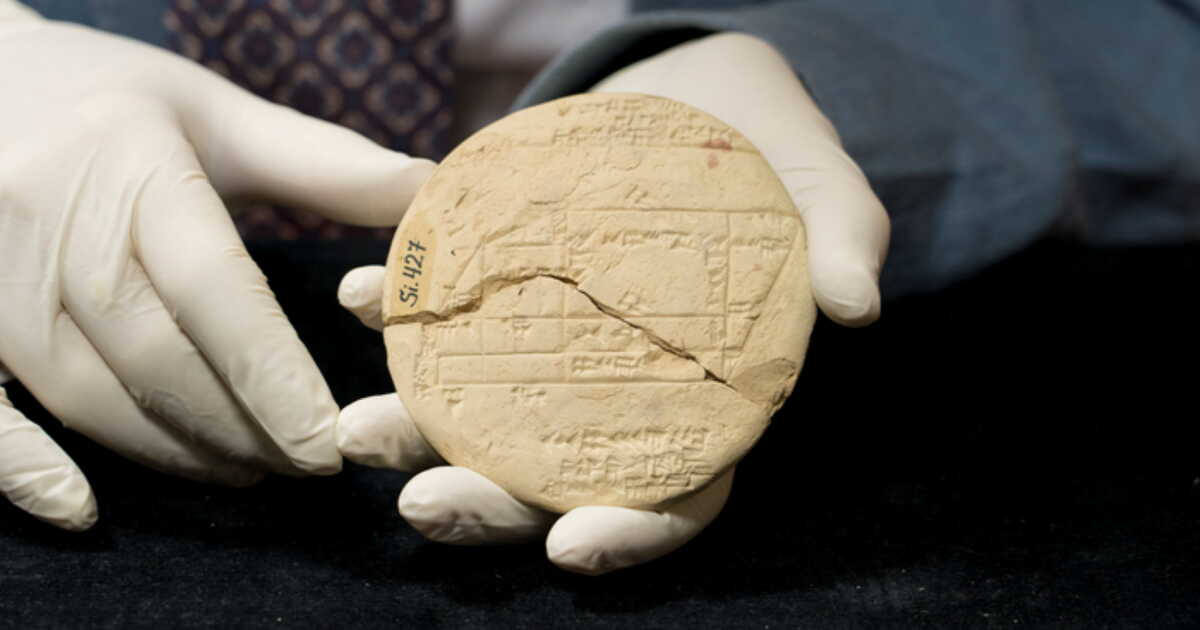
Dr. Daniel Mansfield, an Australian mathematician from the University of New South Wales, stumbled upon an extraordinary find—a Babylonian clay tablet that is approximately 3,700 years old. Named Si.427, this tablet contains what could very well be the oldest known example of applied geometry. The tablet was found to depict land measurements, specifically the boundaries of a property, illustrating a sophisticated approach to geometry far ahead of its time.
The tablet was discovered in modern-day Iraq in the late 19th century and was kept at the Istanbul Archaeological Museum. But it wasn’t until Dr. Mansfield’s research that its mathematical significance became clear. The Si.427 tablet describes a piece of land, including marshy areas, a threshing floor, and a nearby tower, all depicted with mathematical precision. What is most striking is that the Babylonian land surveyor didn’t rely on modern technology like GPS; instead, they employed Pythagorean triples, the very concept attributed to Pythagoras himself—though this discovery shows it predates him by over 1,000 years.
Pythagorean Triples and Practical Mathematics
The discovery of Si.427 is not Dr. Mansfield’s first breakthrough in ancient Babylonian mathematics. Together with Professor Norman Wildberger, Mansfield previously uncovered another tablet, Plimpton 322, which is the oldest and most accurate trigonometric table known. These tablets were likely used for land surveying or construction, essential tasks in ancient times.
Dr. Mansfield explains that the existence of Pythagorean triples—sets of numbers that satisfy the Pythagorean theorem—indicates a high level of mathematical sophistication. “Once you understand what Pythagorean triples are, your society has reached a particular level of mathematical maturity,” Mansfield noted. For him, discovering these ancient mathematical applications reveals the ingenuity of ancient cultures and their practical use of geometry in daily life.
A Look Back at the Mathematical Achievements of the Babylonians
While many people associate Pythagorean triples with the ancient Greek philosopher Pythagoras, these tablets suggest that the Babylonians were already using such concepts well over a millennium before Pythagoras even walked the Earth. The Si.427 tablet not only showcases the application of geometry but also underscores how ancient cultures like the Babylonians were far more advanced in their mathematical understanding than we often give them credit for.
Dr. Mansfield’s findings are a humbling reminder that the human desire to understand the world through mathematics has been an enduring part of our history, long before the formalization of many mathematical principles in the Western world.
In conclusion, the discovery of Si.427 opens a window into the rich and often overlooked world of ancient Babylonian mathematics. It challenges our assumptions about the timeline of mathematical development and reminds us that practical problem-solving in ancient civilizations was often as sophisticated as it was essential to their daily lives. As more research is conducted, we may yet uncover even more groundbreaking discoveries that highlight the brilliance of these ancient thinkers.
NASA warns China could slow Earth’s rotation with one simple move
This dog endured 27 hours of labor and gave birth to a record-breaking number of puppies