
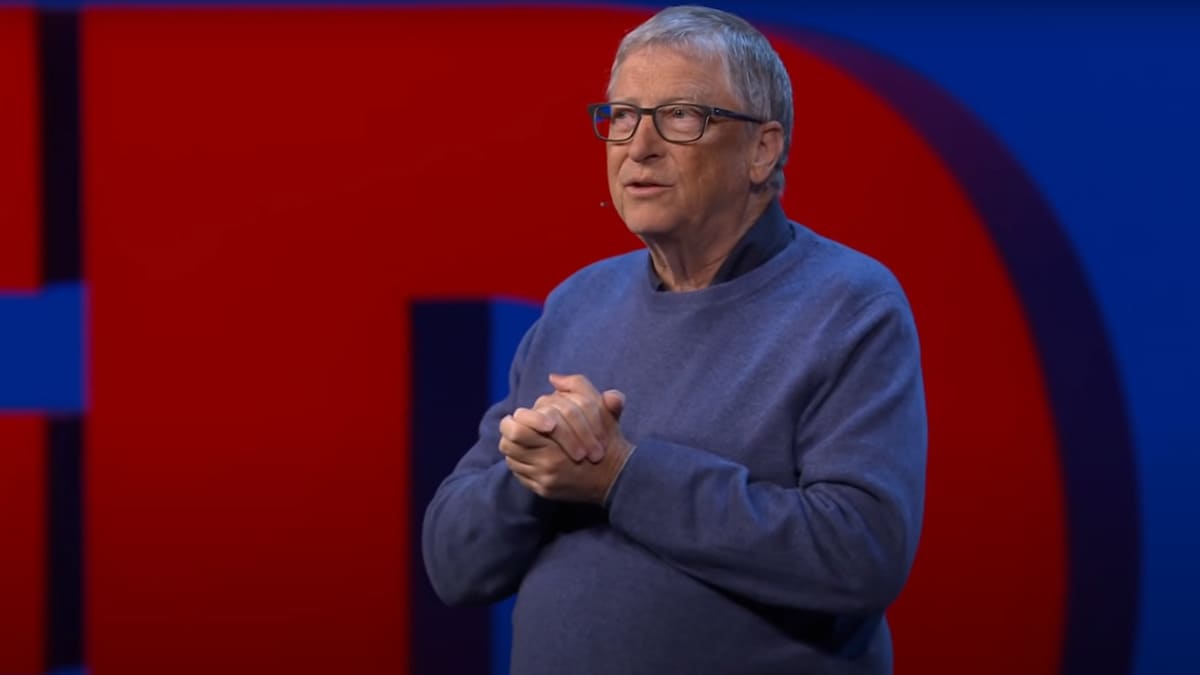
When Bill Gates talks about the future of technology, people tend to listen — and for good reason. With decades of experience at the intersection of software, innovation, and education, his predictions often carry weight. This time, the Microsoft co-founder is turning heads with a bold claim: artificial intelligence is about to crack one of the toughest challenges computers have ever faced — truly understanding and improving human writing and reading.
Amazon co-founder MacKenzie Scott has donated over $19 billion to charity in just five years
Diamond batteries powered by nuclear waste promise 28,000 years of clean energy
The Classroom Gets a Digital Assistant
During a recent event in San Diego, Gates shared his belief that AI-powered chatbots are on the verge of becoming personal tutors for students — and not just for rote learning or math drills. According to him, within the next 18 months, AI will be able to support kids in developing their reading comprehension and writing skills in a way that rivals the feedback of a real teacher.
He explained that current AI models already show “remarkable” understanding of text. This opens the door for tools that can give students personalized guidance on how to structure an essay, expand their vocabulary, or clarify their ideas. In his words, AI will soon be “as good a tutor as any human.”
It’s a vision that resonates. After all, many students today are already using apps to check grammar or summarize texts. But Gates sees something deeper: AI that can offer meaningful commentary on narrative structure, tone, and clarity — elements that are notoriously difficult for traditional software to assess.
Why Teaching Writing Has Always Been a Tech Challenge?
For decades, computers have been great at crunching numbers — but far less impressive when it comes to understanding the subtleties of language. Gates emphasized that teaching a computer to evaluate an essay involves “highly cognitive” tasks: understanding narrative flow, detecting coherence, and offering creative suggestions.
Historically, these have been well beyond the reach of most educational software. Unlike math problems with clear right or wrong answers, writing is subjective, nuanced, and context-dependent. That’s what makes it so hard to replicate with code.
But thanks to large language models like OpenAI’s ChatGPT and Google’s Gemini, that’s changing fast. These systems are now capable of parsing and generating complex human language at a level that sometimes surprises even their creators.
NASA warns China could slow Earth’s rotation with one simple move
This dog endured 27 hours of labor and gave birth to a record-breaking number of puppies
Reading and Writing First, Then Math
Interestingly, Gates believes AI’s greatest near-term impact will come in reading and writing — not mathematics. That may seem counterintuitive. After all, isn’t AI built on math? But understanding how someone expresses an idea, and helping them express it better, requires a different kind of intelligence — one that combines logic, empathy, and intuition.
Still, Gates doesn’t see this as the endpoint. He predicts that after mastering the art of communication, AI tutors will also enhance how students engage with subjects like algebra and calculus. But for now, the priority is unlocking human potential through better literacy tools.
A New Era of Learning
We’ve all had that moment: staring at a blank page, unsure how to start a sentence or wondering whether our argument makes sense. If Gates is right, future students may not face that moment alone. AI will be there — not to write for them, but to coach them. To nudge, explain, suggest.
Of course, like any tool, AI will need to be used wisely. Teachers will remain irreplaceable, especially when it comes to fostering critical thinking and emotional growth. But imagine a world where every child has access to their own tireless tutor, offering thoughtful feedback and helping them build skills for life.
For Gates, that’s not a sci-fi dream. It’s just around the corner.