
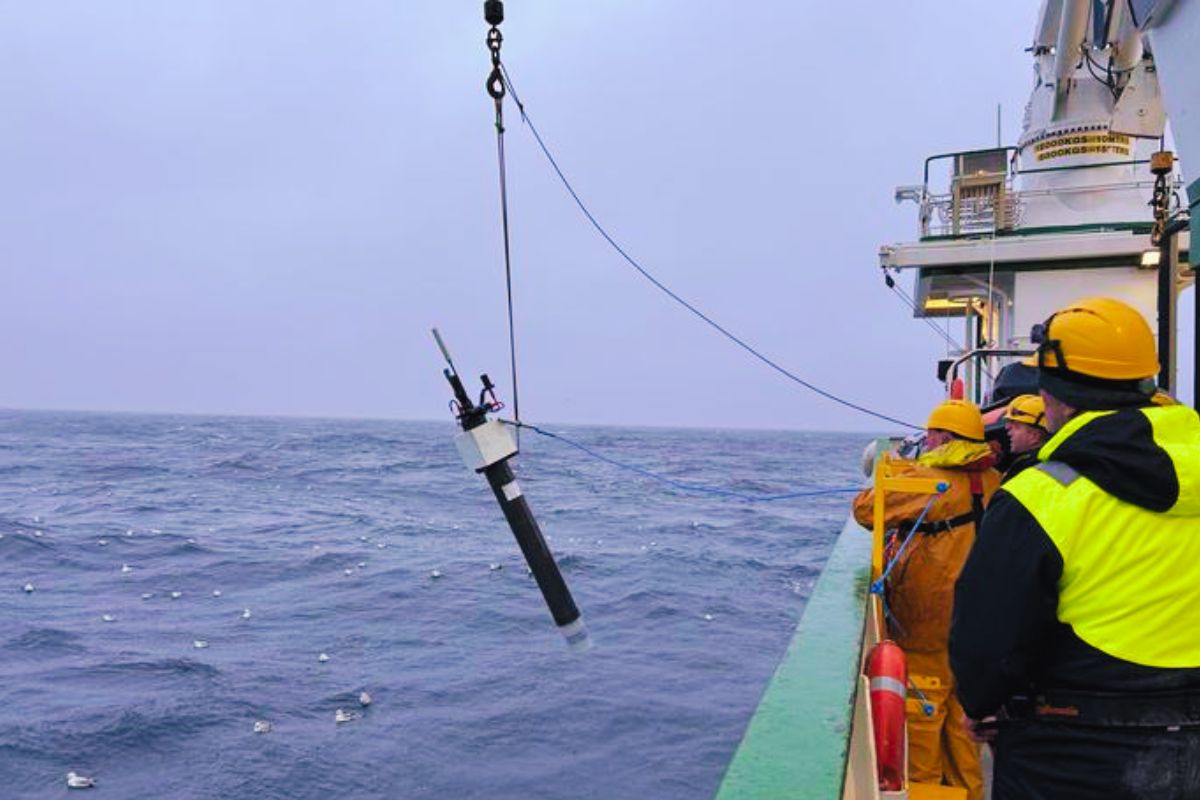
In the dark, silent depths of our oceans, a discovery of staggering scale has just been made. Thanks to Canadian innovation and a network of smart underwater robots, scientists have revealed a vast, hidden biomass that could reshape what we know about the sea—and the planet itself. To put it in perspective: we’re talking about an organic mass equivalent to 250 million elephants, drifting silently beneath the waves.
Amazon co-founder MacKenzie Scott has donated over $19 billion to charity in just five years
Diamond batteries powered by nuclear waste promise 28,000 years of clean energy
A secret ocean world revealed by robotic explorers
Most of us think of ocean life in terms of what we can see—coral reefs, dolphins, or schools of fish glinting in the sun. But beneath all that, far below the surface, lies an invisible but essential force: phytoplankton. These microscopic organisms are the building blocks of the marine food chain, yet they’re too small to spot with the naked eye.
Now, thanks to 903 robotic floats deployed through the Biogeochemical-Argo (BGC-Argo) program, researchers have finally measured their true global presence. The result? A jaw-dropping 314 teragrams of biomass—that’s 346 million metric tons—lurking in the ocean depths. When I chatted with a marine scientist friend last summer about these robots, she called them “our new deep-sea detectives.” And indeed, they’ve uncovered a world we’ve barely begun to understand.
Tiny plants, massive climate impact
Phytoplankton may be microscopic, but they play a massive role in climate regulation. They absorb carbon dioxide during photosynthesis—just like trees do on land—and help store it in the ocean. They also produce nearly half of the oxygen we breathe, making them one of the unsung heroes of Earth’s climate system.
I once watched a nature documentary that called phytoplankton “the lungs of the ocean.” It stuck with me. According to the National Oceanic and Atmospheric Administration (NOAA), these ocean plants are crucial in slowing down global warming, acting as a vast carbon sink that helps stabilize Earth’s temperature. Without them, our climate models would be wildly off—and our planet, far warmer.
How robots are transforming climate science
Until now, most of what we knew about phytoplankton came from satellite imagery, which can only track surface blooms. But these new robotic floats dive deep, collecting real-time data from layers satellites can’t reach. It’s like switching from a black-and-white sketch to a full-color photograph of the ocean’s inner workings.
With these insights, scientists are now refining climate prediction models, offering more accurate forecasts for how oceans absorb carbon and respond to warming. International climate monitoring organizations have praised this data as a breakthrough that could inform smarter, more effective environmental policies worldwide.
NASA warns China could slow Earth’s rotation with one simple move
This dog endured 27 hours of labor and gave birth to a record-breaking number of puppies
A leap forward for ocean research
The BGC-Argo network isn’t just a cool tech story—it’s a glimpse of the future of environmental science. These robotic floats are lightweight, autonomous, and capable of gathering data over long periods without human interference. They’re already transforming how we track marine ecosystems, and their applications extend far beyond phytoplankton.
It’s a bit humbling to think that devices once developed for oil exploration are now being used to protect the ocean. The same tech that once drilled into the Earth is now helping us understand it better—and that shift speaks volumes about how science evolves to meet the planet’s most urgent needs.
The weight of the invisible world
The discovery of 250 million elephants’ worth of microscopic marine life isn’t just a scientific triumph—it’s a reminder of how much we still don’t know. As climate threats grow more serious, this kind of innovative, data-driven exploration is exactly what we need to adapt, respond, and protect.
The oceans have always held secrets. Now, with a little robotic help and a lot of scientific curiosity, we’re finally starting to unlock them.