
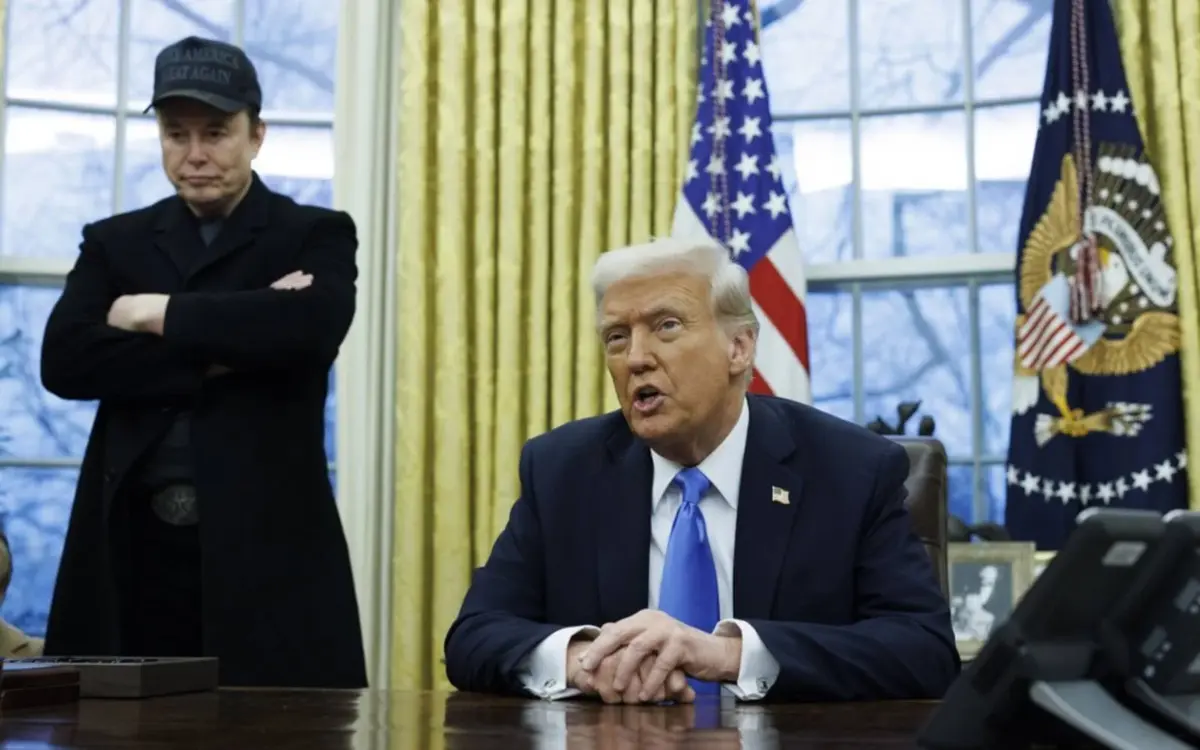
Elon Musk, through his company Starlink, has provided satellite internet access to the White House. Officially, this contribution is recognized as a donation, which has been approved by the legal office of the presidency. According to spokesperson Karoline Leavitt, the purpose is to “enhance Wi-Fi connectivity across the complex” due to poor network coverage in some buildings.
Amazon co-founder MacKenzie Scott has donated over $19 billion to charity in just five years
Diamond batteries powered by nuclear waste promise 28,000 years of clean energy
Concerns Over Cybersecurity Implications
The installation of the Starlink service did not follow the usual protocol. Typically, terminals are set up directly on the facilities to receive the satellite signal. However, in this instance, the connection is routed through a government data center located miles away from the White House and then transmitted via optical fiber—a notably peculiar approach.
The deployment of Starlink at a highly secure site like the White House has raised several cybersecurity concerns. Jake Williams, a cybersecurity expert, told the New York Times that it is uncommon to replace a securely established government infrastructure with an external service like Starlink. This raises additional questions since the White House’s internet network already relies on fiber cables, which are considered more reliable and secure than satellite connections.
Another significant issue occurred during the installation of Starlink, which triggered an alert within the complex. A project employee accessed the roof of a government building without prior coordination with security services, prompting a response from the Secret Service.
Potential Conflict of Interest
Elon Musk, who holds an unpaid position as a “special advisor to the government,” maintains close relationships with various federal agencies. This proximity has raised concerns, especially regarding a potential contract between Starlink and the Federal Aviation Administration (FAA). According to Rolling Stone, FAA officials were reportedly instructed to expedite a program to deploy Starlink terminals for air traffic control.
These revelations prompted three Democratic senators—Elizabeth Warren, Richard Blumenthal, and Chris Van Hollen—to call for an investigation into potential conflicts of interest. In a letter to the Department of Transportation and the Department of Justice, they questioned Musk’s exact role in these decisions and whether his company might unfairly benefit.
Increasing Dependence on Private Companies
The use of Starlink by the White House raises broader questions about the role of private companies in critical government infrastructure. Officially, the donation aims solely to improve the complex’s Wi-Fi connection, but there were likely other less unconventional methods available. Beyond the initiative itself, relying on a service controlled by a private company, whose leader has ties with the executive branch, once again blurs the line between public and private interests.