

When I stood on the windswept coast of Denmark last autumn, squinting across the Baltic at Germany’s distant shoreline, it was hard to picture anything but whitecaps and gulls. Yet beneath those waves a feat of engineering audacity is taking shape—one that promises to redraw Europe’s transport map and set new standards for green construction. Welcome to the Fehmarnbelt Tunnel.
Amazon co-founder MacKenzie Scott has donated over $19 billion to charity in just five years
Diamond batteries powered by nuclear waste promise 28,000 years of clean energy
A record-breaking passage under the Baltic
Stretching roughly 19 km, the Fehmarnbelt Tunnel will become the world’s longest immersed tunnel carrying both road and rail. Each of its 73 000-tonne concrete sections is cast on land, then floated out and gently sunk into a trench 40 m below sea level—think giant Lego bricks, but on a scale that would dwarf a football stadium. Danish operator Femern A/S and German partners coordinate this high-stakes choreography, a collaboration EuroConstruct hails as a model for future megaprojects.
Slashing travel times and boosting trade
Right now, travellers depend on ferries that linger about 45 minutes on the water. Once the tunnel opens, a seven-minute train ride or ten-minute drive will knit Denmark and Germany together. Picture a family zipping from Copenhagen to Hamburg for a spur-of-the-moment weekend, or a logistics manager shaving hours—and costs—off a supply route. Dr. Lena Mikkelsen of the European Transport Institute expects freight efficiency to surge, deepening economic ties “from Scandinavia to the Alps.”
Building beneath the waves: logistics on a grand scale
The beating heart of the project is Rødbyhavn, a temporary port and prefab yard sprawling over the area of 140 football fields. Here, six production lines churn out 79 standard tunnel elements and 10 specialised segments housing ventilation and emergency systems. Each 217-m-long block is towed by tug to its final resting place, a process the site manager likens to “dancing with concrete whales.” MarineLogistics International recently cited the yard as a benchmark for large-scale maritime construction.
Moving mountains—of sediment
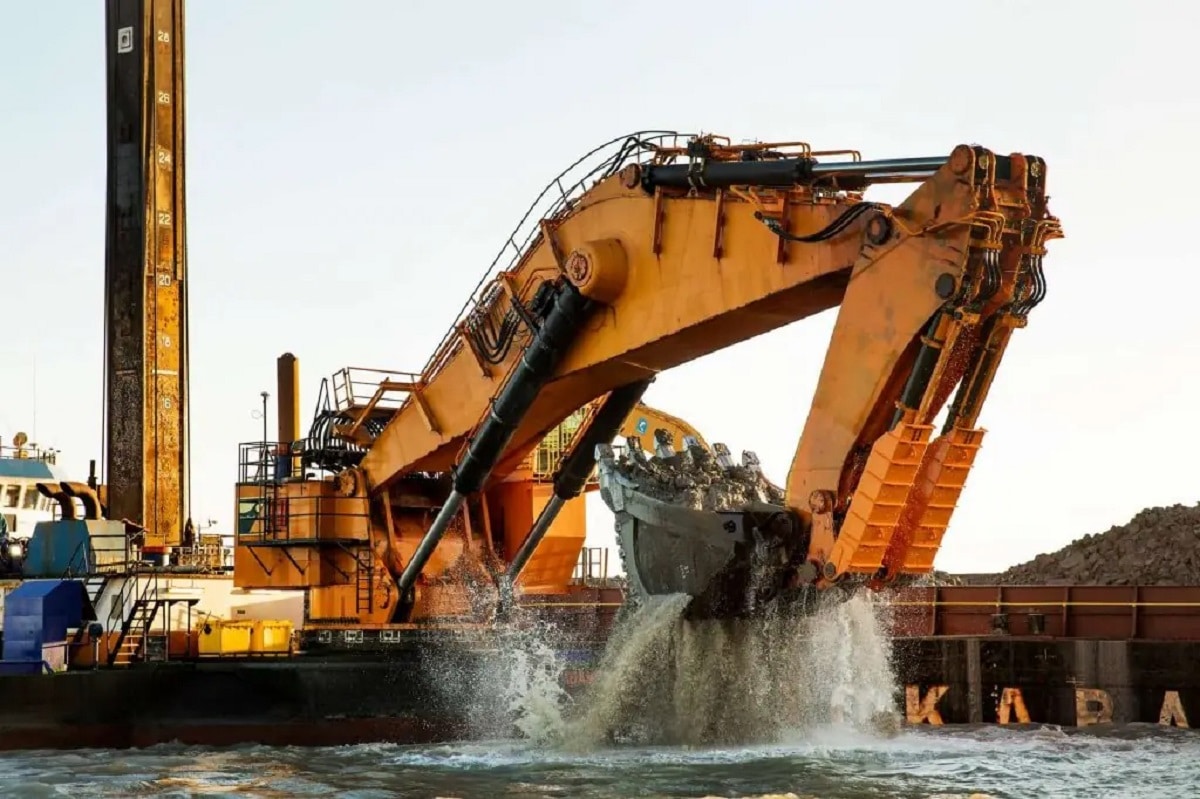
On the German shore at Puttgarden, an armada of dredgers is excavating a 12-m-deep trench, relocating 19 million m³ of seabed to make room for the tunnel. GeoEngineering Europe notes that millimetre-level accuracy is vital to ensure every segment slots together seamlessly—any misalignment would echo along the entire link.
Greener transport, richer seas
By funnelling more freight onto electrified rail, the tunnel should dramatically cut CO₂ emissions, supporting the EU’s climate targets. Project planners are also installing artificial reefs to encourage marine life, an initiative GreenTech Europe applauds for balancing infrastructure needs with biodiversity. During a recent visit, a marine biologist pointed out juvenile cod already exploring the first reef modules—an early sign the scheme can create environmental winners as well as economic ones.
Bridging cultures as well as coasts
Beyond the headline metrics, the Fehmarnbelt Tunnel is a cultural conduit. A delicatessen owner in Aarhus told me she’s eager to ship Danish cheeses to Munich “without the ferry timetable in the way,” while German tour operators foresee new weekend circuits looping Copenhagen, Lübeck, and beyond. Shorter journeys invite fresh collaborations—from student exchanges to cross-border gigs—and knit northern Europe a little tighter.
NASA warns China could slow Earth’s rotation with one simple move
This dog endured 27 hours of labor and gave birth to a record-breaking number of puppies
The numbers behind the vision
| Key metric | Value |
|---|---|
| Scheduled opening | 2029 |
| Project budget | € 6.6 billion |
| Concrete required | 3.2 million m³ |
| Reinforcement steel | 360 000 tonnes |
| Standard elements | 79 |
| Special elements | 10 |
| Typical element size | 217 m × 42 m × 10 m |
| Sediment removed | 19 million m³ |
A blueprint for future megaprojects
Cost overruns and ecological concerns shadow every undertaking of this magnitude, but so far the Fehmarnbelt team is holding course. Global Infrastructure Watch praises the project’s governance, noting that lessons learned here—from modular immersion to habitat offsets—could guide tunnels under the Strait of Gibraltar or Canada’s Fraser River.
As the Baltic wind whipped my notebook pages, I imagined the day passengers trade the ferry deck for a high-speed train shooting beneath the waves. It’s an audacious vision—one that could make northern Europe feel smaller, greener, and more connected than ever. If the Fehmarnbelt Tunnel delivers on its promise, it won’t just set records; it will redefine what modern infrastructure can achieve.