
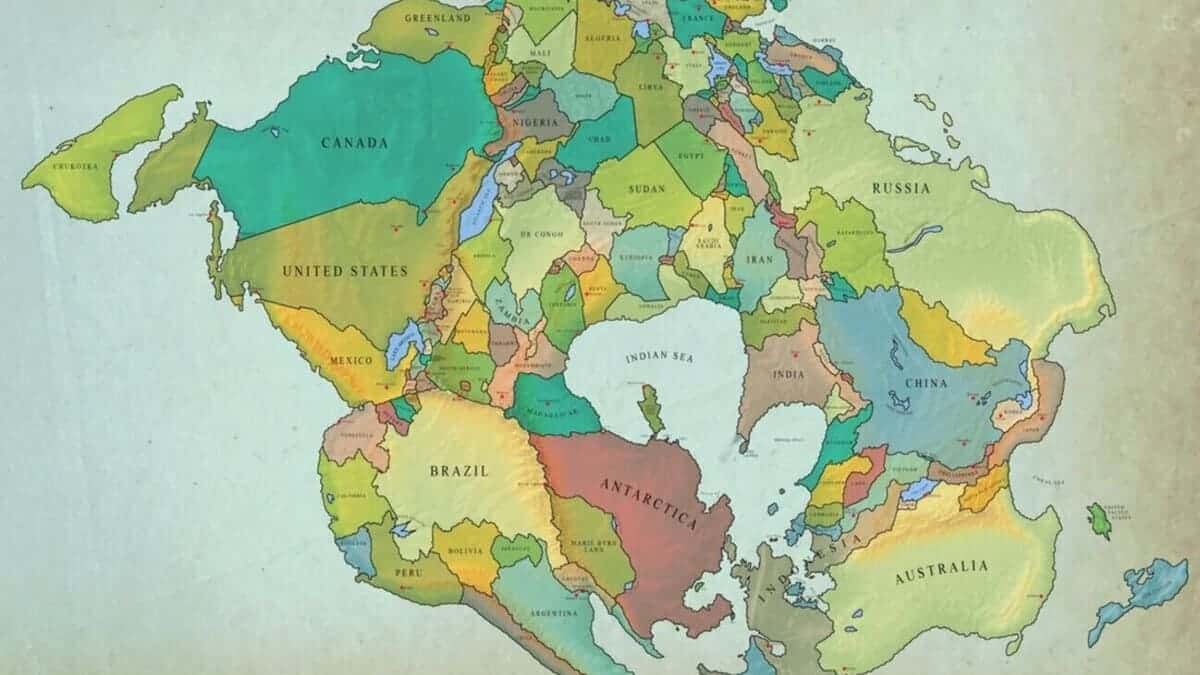
Imagine glancing at a map that doesn’t resemble any you’ve seen before—a map where continents slowly drift together to form one gigantic landmass. It might sound like a page out of a futuristic novel, yet this is the potential destiny of our ever-changing planet, as predicted by scientists studying Earth’s slow but relentless tectonic ballet.
Amazon co-founder MacKenzie Scott has donated over $19 billion to charity in just five years
Diamond batteries powered by nuclear waste promise 28,000 years of clean energy
The Science Behind Supercontinents
Think of Earth’s surface as a colossal jigsaw puzzle, where each piece is a tectonic plate, moving imperceptibly over time. I recall watching a documentary by the National Geographic Society, where experts compared these gradual shifts to the slow dance of glaciers—a process that, although nearly invisible day-to-day, reshapes our planet over millions of years. In our geological history, supercontinents have risen and fallen. For instance, around 335 million years ago, the legendary Pangaea dominated before eventually breaking apart into the continents we know today. Even earlier, formations like Columbia and Rodinia played similar roles, coming together and then fragmenting in a continuous cycle.
Using advanced seismic data and comprehensive geological models, researchers have started to draft maps predicting the next supercontinent. Their work brings together Life Cycle Assessments and other sophisticated methods to envisage a world transformed by the slow movement of Earth’s plates.
What Could the Next Supercontinent Look Like?
Forecasting the precise layout of continents 250 million years into the future is an enormous challenge. Variables such as the pace of plate movements and unexpected geological interactions add layers of complexity. Despite these uncertainties, experts have outlined several possible scenarios:
-
Novopangaea: Imagines continents drifting to close off the Pacific Ocean.
-
Aurica: Envisions a world where India becomes the linchpin, drawing neighboring continents together.
-
Amasia: Suggests a dramatic collision between North America and Asia near the Arctic region.
-
Pangaea Proxima (or Next Pangaea): Likely the most realistic scenario, predicts the convergence of Africa, the Americas, Eurasia, Australia, and Antarctica into one vast landmass.
Each of these models offers a unique vision of Earth’s future, blending rigorous scientific analysis with a bit of creative speculation.
A Glimpse of Pangaea Proxima
Among these projections, Pangaea Proxima stands out as a particularly compelling image of our planet’s future. According to detailed studies led by renowned paleogeographers such as C. R. Scotese, nearly all existing continents could one day merge into a single supercontinent surrounded by a colossal global ocean. Imagine the profound implications: South America could join forces with Africa, and Europe might shift northwards to become a neighbor to what is now Asia. I remember a conversation with a friend who is an amateur geologist; he was fascinated by the idea of a “new world order” among continents, where familiar geographical boundaries are redrawn in ways we can barely comprehend today. Prestigious organizations like the American Geophysical Union have highlighted such models as pivotal in understanding long-term Earth evolution.
Why It’s More Than Just an Interesting Thought Experiment ?
The implications of studying supercontinents extend far beyond satisfying our curiosity about the future. These massive landmasses play a critical role in governing climate patterns, ocean currents, and even the evolution of life itself. For example, changes in continental arrangements can trigger shifts in global weather patterns and precipitate extreme climatic events—a topic that researchers at The Intergovernmental Panel on Climate Change (IPCC) often discuss when predicting long-term environmental changes.
By unraveling how these supercontinents form and disintegrate, scientists gain valuable insights into the past, present, and future of our environment. This knowledge helps us understand phenomena ranging from biodiversity shifts to the distribution of natural resources, ultimately informing policies that address current environmental challenges.
NASA warns China could slow Earth’s rotation with one simple move
This dog endured 27 hours of labor and gave birth to a record-breaking number of puppies
Final Thoughts
While none of us will witness the formation of a new supercontinent in our lifetime, these predictions remind us of Earth’s incredible dynamism. They offer a humbling perspective on our place in the vast timeline of our planet’s history. As we marvel at these fascinating maps and models, we are also encouraged to think about the long-term impacts of natural forces that operate at scales far beyond our everyday experience. In the grand narrative of Earth, the formation of a future supercontinent is not just a speculative idea—it’s a bold chapter waiting to be written by the relentless movement of tectonic plates.