
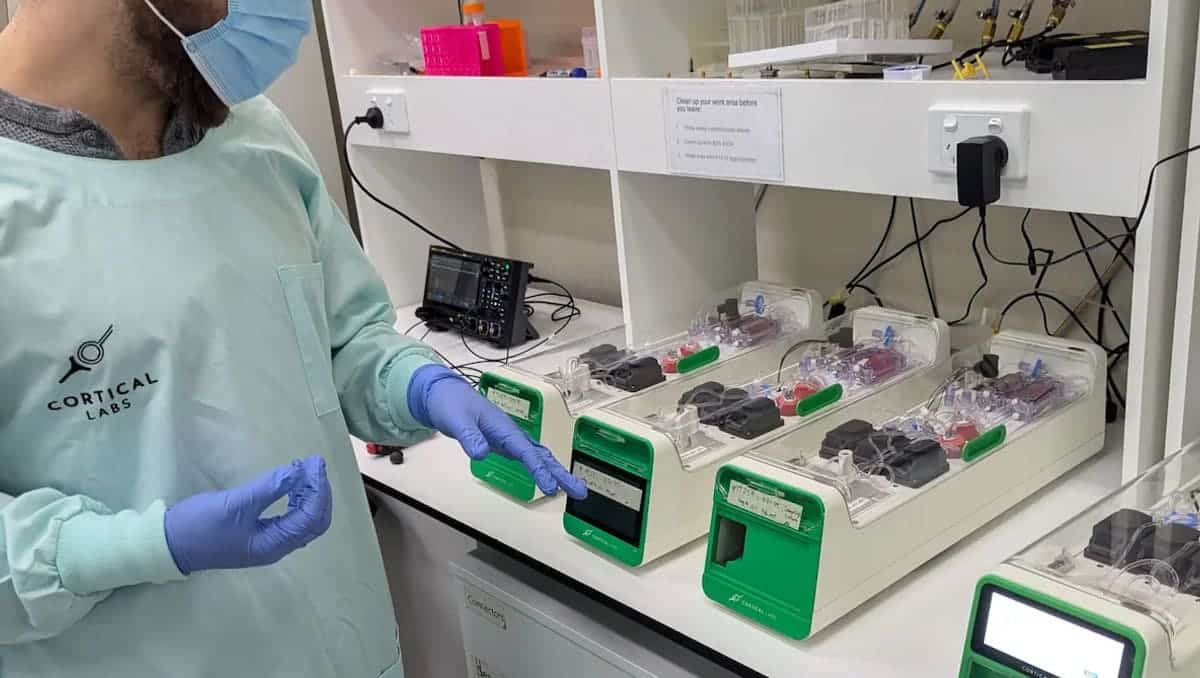
What if your next AI upgrade involved living brain cells instead of circuits? A pioneering device called the CL1 lets you rent a mini “biocomputer” powered by human neurons for just €300 a week.
Amazon co-founder MacKenzie Scott has donated over $19 billion to charity in just five years
Diamond batteries powered by nuclear waste promise 28,000 years of clean energy
CL1: The First Biological Computer Driven by Human Neurons
Imagine swapping out GPUs for real neurons. That’s precisely what Cortical Labs unveiled at MWC Barcelona 2025 with their CL1 biocomputer. Packed with roughly 800,000 living neurons cultivated from human blood or skin cells, the CL1 runs in a self-contained automated incubator—consuming under 50 W of power—while learning at a startling pace¹. Researchers can lease one for €300 a week or purchase it for around €35,000² and plug it into everyday machinery—no lines of code required. In demos, the neuronal network mastered Pong and navigated obstacles using genuine synaptic activity rather than programmed instructions.
Did you know? The concept of “brain-on-a-chip” dates back to 2018, when researchers first demonstrated neural cultures controlling simple robotic behaviors.
Lab-Grown Mini-Brains Pilot Robots and More
Across the globe—from Tianjin University in China to Cortical Labs in Australia—“brain-on-chip” platforms are emerging as living AI testbeds. Scientists differentiate stem cells into neurons, seed them onto microelectrode arrays, and watch as these organoids encode signals, decode feedback, and drive robotic arms. One team taught their cerebral spheroids to avoid obstacles; another integrated theirs into a gripper that sorted objects by shape. While long-term stability, cell nutrition, and standardized training remain challenges, the technology promises breakthroughs in medical testing, neurological modeling, and adaptive robotics—all while reducing reliance on animal studies.
This isn’t science fiction but a paradigm shift: we’re entering an era of hybrid machines that feel, react, and learn through living tissue. Ethical debates are already bubbling up—after all, can we truly “use” living neurons for AI? But for now, researchers can explore the frontier of organic computation, renting a slice of human brain power for less than the cost of a high-end GPU.
Footnotes
-
Cortical Labs, “CL1 Specifications and Performance,” ; https://corticallabs.com/cl1.html
-
Biopharma Trend, “CL1 Pricing and Leasing Options,” ; https://www.biopharmatrend.com/post/1156-cortical-labs-introduces-biological-computer-built-on-human-brain-cells/