
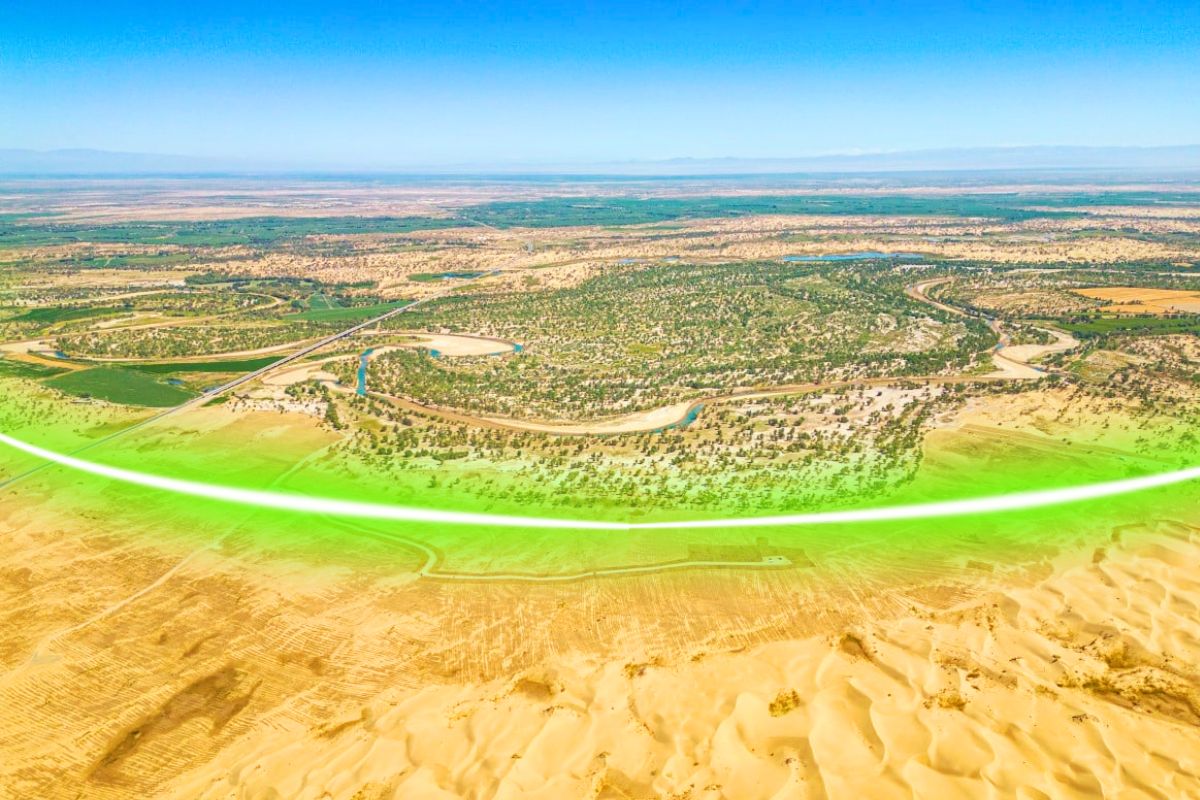
The Taklamakan Desert, one of the largest and most unforgiving deserts on the planet, has been gradually contained through an extraordinary environmental initiative led by China. Stretching 3,050 kilometers, this greenbelt project aimed to stop the desert’s expansion, protect vital infrastructure, and create new opportunities for the Xinjiang Uyghur Autonomous Region.
Amazon co-founder MacKenzie Scott has donated over $19 billion to charity in just five years
Diamond batteries powered by nuclear waste promise 28,000 years of clean energy
A Desert Stopped by Innovation
Covering an area of 337,600 square kilometers—roughly the size of Germany—the Taklamakan Desert has been a significant threat for decades. With its vast shifting sand dunes and frequent, damaging sandstorms, the desert disrupts weather patterns, threatens agriculture, and poses serious health risks. In response, China initiated a project to create a green barrier, a massive greenbelt designed to lock the desert in place and stabilize its fragile environment.
This environmental feat involved the strategic planting of desert-friendly species, such as desert poplar, red willow, and saxaul trees, known for their ability to thrive in arid conditions. The goal was to anchor the shifting sands, slow the desert’s expansion, and provide long-term ecological and economic benefits. This greenbelt not only protects crucial infrastructure like railways and highways but also serves as a powerful example of how sustainable technology can help combat desertification.
A 40-Year Mega Project with 600,000 Workers
This monumental greenbelt project has been in the works for over four decades. The first 2,761 kilometers were completed over the years, but the final phase, launched in November 2022, marked a milestone as it mobilized 600,000 workers to plant and nurture resilient plant species across the harsh terrain. These workers planted trees that serve multiple purposes—anchoring the soil, reducing the risk of sandstorms, and creating new economic opportunities for local communities.
The project stands as one of the most ambitious reforestation efforts ever undertaken, setting a new standard for large-scale desert restoration around the world. The long-term vision goes beyond just stopping desertification; it’s about creating a sustainable ecosystem that benefits both people and the environment.
Economic and Environmental Breakthroughs
While the primary goal of this greenbelt is to halt the desert’s advance, the initiative has also created significant economic opportunities. Some of the newly planted species, such as desert hyacinth, have medicinal properties, potentially opening up lucrative markets for herbal remedies and natural products.
Additionally, the project has helped improve the region’s infrastructure. In 2022, China opened the Hotan-Ruoqiang Railway, the world’s first railway to completely encircle a desert. This 2,712-kilometer railway facilitates the transportation of agricultural products, such as walnuts and red dates, to markets across China, boosting regional trade and development.
A Renewable Energy Hub in the Making
The greenbelt is just one part of China’s broader vision for the Taklamakan Desert. In addition to reforestation, a massive renewable energy initiative is underway. Spearheaded by the China Three Gorges Corporation, the project aims to install 8.5 gigawatts of solar power and 4 gigawatts of wind energy, with plans for completion within the next few years.
NASA warns China could slow Earth’s rotation with one simple move
This dog endured 27 hours of labor and gave birth to a record-breaking number of puppies
This development positions Xinjiang as a key player in China’s clean energy strategy, integrating the region’s abundant renewable resources into the national grid. By combining desert restoration with sustainable energy production, China is transforming the Taklamakan Desert from an ecological challenge into a cornerstone of green development.
A Model for Global Desertification Efforts
China’s success with the Taklamakan greenbelt serves as an inspiration for other countries facing similar desertification challenges. Efforts like Africa’s Great Green Wall, which aims to halt the expansion of the Sahara Desert through a vast tree-planting project, show that large-scale afforestation can be a powerful tool in the fight against desertification.
The combination of solar energy, afforestation, and economic incentives makes China’s approach a model for desert restoration projects around the world. The next phase of this project will focus on optimizing its long-term effectiveness, ensuring that it remains a sustainable and self-sufficient ecosystem.
Pioneering Solutions for a Sustainable Future
China’s innovative environmental solutions have set a new precedent for addressing desertification. By leveraging cutting-edge solar-powered sand control technology, large-scale reforestation, and renewable energy, China has demonstrated that desertification is not an irreversible process. With continued investment and research, other regions suffering from encroaching deserts may follow China’s lead, proving that with the right strategies, even the harshest environments can be transformed into thriving ecosystems.