
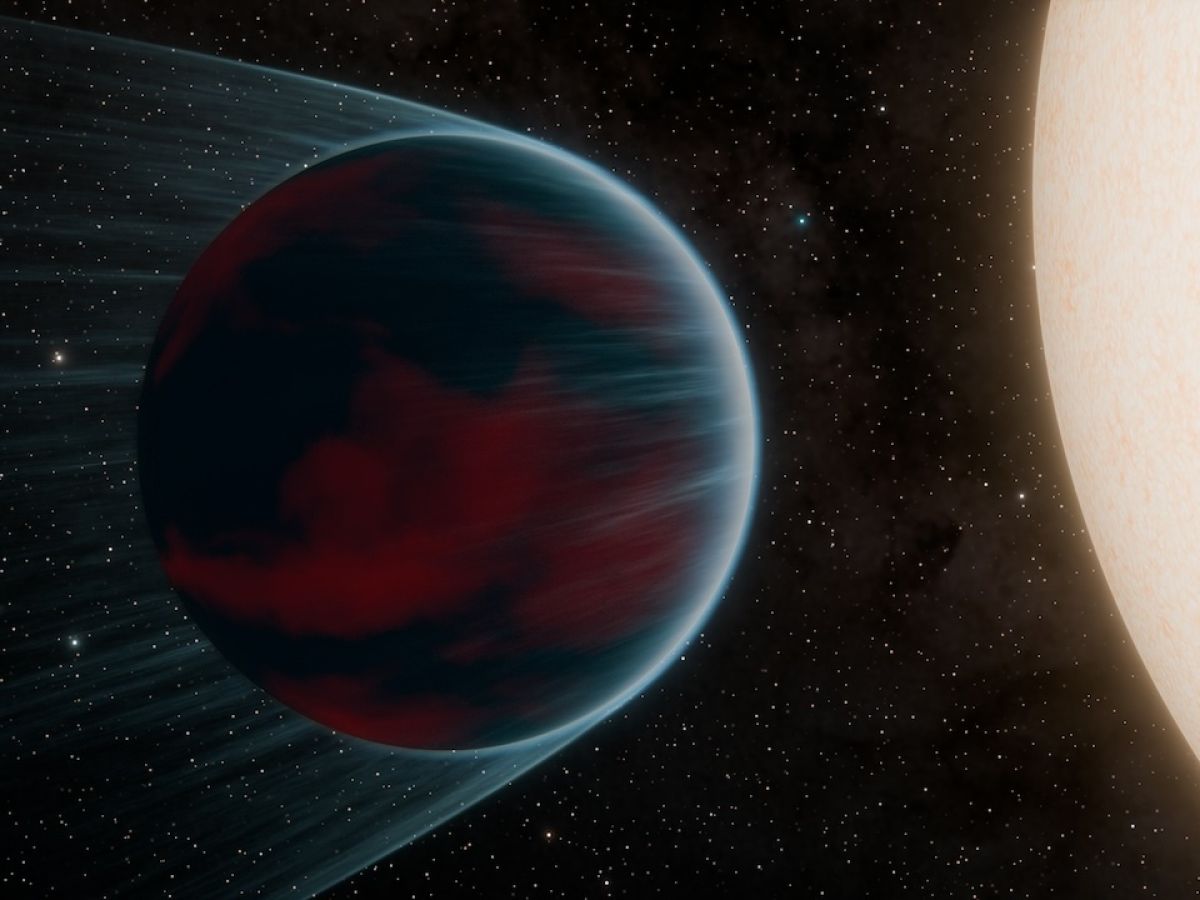
Astronomers have identified a mysterious exoplanet that challenges existing theories of planet formation. Located in what scientists call Neptune’s Desert, this celestial body—TOI-3261 b—is an ultra-short-period hot Neptune, meaning it shares a similar size to Neptune but orbits extremely close to its host star, completing a full revolution in just 21 hours.
Amazon co-founder MacKenzie Scott has donated over $19 billion to charity in just five years
Diamond batteries powered by nuclear waste promise 28,000 years of clean energy
A Rare Find in an Extreme Environment
The Neptune Desert refers to the scarcity of Neptune-sized planets with orbits shorter than four days. While astronomers have found hot Jupiters and rocky super-Earths in this region, Neptune-class planets remain incredibly rare—with only four identified so far, the first of which was detected in 2020.
TOI-3261 b was first spotted by NASA’s TESS (Transiting Exoplanet Survey Satellite) before ground-based telescopes in Chile, South Africa, and Australia confirmed its presence and refined its characteristics. According to a study published in The Astronomical Journal, this planet exhibits an unusually high density, suggesting a composition rich in heavy elements like metals, rather than the lighter gases typically expected in Neptune-like worlds.
How Did This Planet Form?
The origins of TOI-3261 b present a major puzzle for astronomers. One prevailing theory suggests that it began as a much larger gas giant, similar to Jupiter, before undergoing significant atmospheric loss. This could have happened due to two key processes:
- Gravitational erosion, where the planet’s extreme proximity to its star gradually stripped away its outer layers.
- Photo-evaporation, where intense stellar radiation heated the atmosphere to the point where lighter gases, such as hydrogen and helium, escaped into space.
This process would explain why the planet appears more compact and metal-rich, with far less of its original atmosphere remaining.
A 6.5-Billion-Year Journey
Researchers estimate that TOI-3261 b formed around 6.5 billion years ago, possibly further away from its star before gravitational interactions—potentially with undetected neighboring planets—forced it onto its current, ultra-tight orbit. This scenario could apply to the other three hot Neptunes found in similar extreme conditions, suggesting that planetary migration may be more common than previously thought.
What Comes Next?
The James Webb Space Telescope (JWST) is expected to observe TOI-3261 b in the coming months, offering an opportunity to analyze its atmosphere and composition with unprecedented precision. These observations could provide critical insights into how gas giants evolve in extreme environments, shedding new light on the formation and transformation of planets across the galaxy.
With each new discovery, the boundaries of planetary science continue to be redefined, proving that the universe is still full of surprises waiting to be uncovered.
NASA warns China could slow Earth’s rotation with one simple move
This dog endured 27 hours of labor and gave birth to a record-breaking number of puppies