
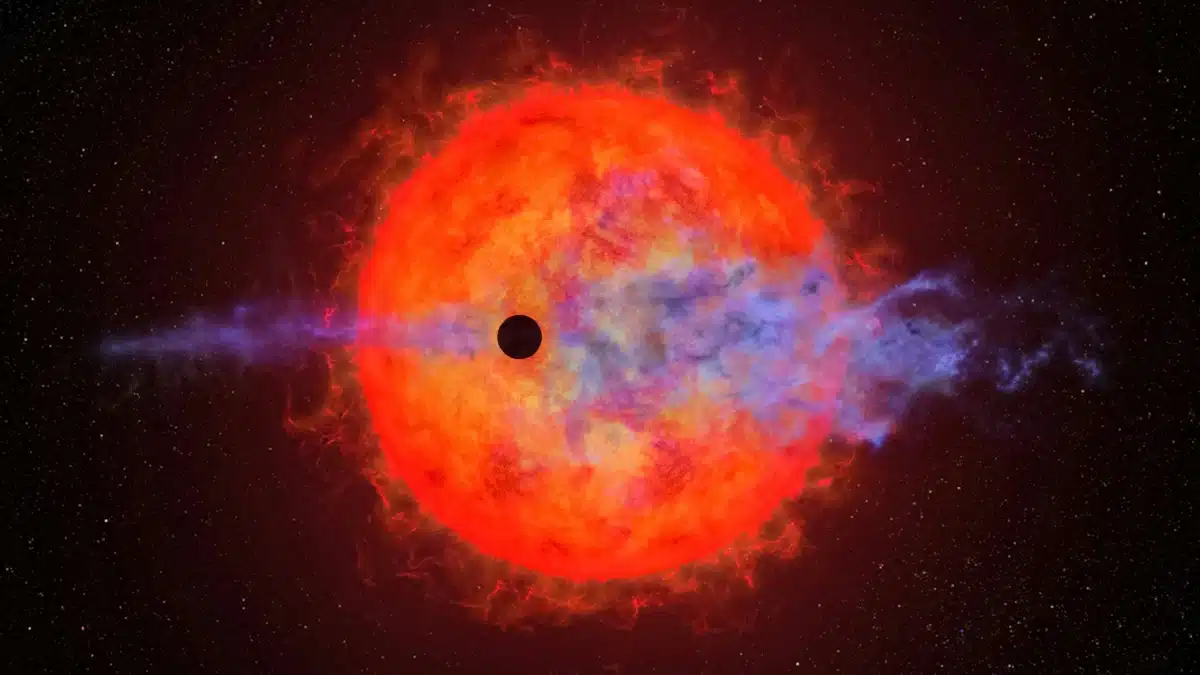
Imagine gazing up at the night sky and spotting a second moon gracefully orbiting our planet, even if just for a short while. This extraordinary event is set to become reality in the coming days as a small asteroid prepares to join Earth’s celestial dance, creating a spectacle that feels like something straight out of a science fiction novel.
Amazon co-founder MacKenzie Scott has donated over $19 billion to charity in just five years
Diamond batteries powered by nuclear waste promise 28,000 years of clean energy
A Temporary Second Moon – Asteroid 2024 PT5

Earlier this year, the ATLAS (Asteroid Terrestrial-impact Last Alert System), funded by NASA, detected a tiny asteroid named 2024 PT5. Originating from the Arjuna asteroid belt, which orbits the Sun, this asteroid is on a unique path that will bring it into a temporary orbit around Earth for about two months. Scientists from the Complutense University of Madrid have meticulously tracked its journey over the past three weeks, confirming that 2024 PT5 will become a fleeting companion to our planet.
Dr. Elena Martínez, a prominent astronomer involved in the study, shared her excitement: “Capturing an asteroid like 2024 PT5 is a rare opportunity. It allows us to study the gravitational interactions between Earth and near-Earth objects in unprecedented detail.”
Tracking the Journey of 2024 PT5
The journey of 2024 PT5 is a testament to the advancements in asteroid detection and tracking technologies. Thanks to the ATLAS system based in Sutherland, South Africa, scientists were able to identify and monitor this asteroid long before it approached Earth. Over 21 days, researchers analyzed its trajectory, predicting that Earth’s gravitational pull would temporarily capture it, creating what can be described as a “mini-moon.”
Historically, similar events have occurred, though rarely. For instance, asteroid 2020 CD3 was captured by Earth’s gravity for several years before it eventually drifted away in 2020. Another asteroid, 2022 NX1, served as a temporary moon twice—in 1981 and 2022—and is expected to return around 2051. Compared to its predecessors, 2024 PT5 is larger and is projected to remain in Earth’s vicinity until approximately 2055.
Two Months and Then It’s Gone
The gravitational dance between Earth and 2024 PT5 will last for about two months. During this period, the asteroid will follow a horseshoe-shaped orbit around our planet, maintaining a close but temporary relationship. On January 9, 2025, 2024 PT5 will make its closest approach before resuming its usual path around the Sun.
While this event won’t be visible to the naked eye for most people, it presents a fascinating opportunity for professional astronomers equipped with powerful telescopes. “Amateur astronomers might miss this event without specialized equipment, but the data we gather will be invaluable for understanding asteroid behavior and Earth’s gravitational influences,” explained Dr. Martínez.
NASA warns China could slow Earth’s rotation with one simple move
This dog endured 27 hours of labor and gave birth to a record-breaking number of puppies
After leaving Earth’s orbit, 2024 PT5 will remain in our celestial neighborhood for a few more months before drifting away. Its next return is anticipated in about three decades, adding a layer of anticipation for future observations.
The Significance of Temporary Moons
Temporary moons like 2024 PT5 offer more than just a celestial show; they provide scientists with crucial insights into the dynamics of near-Earth objects and their interactions with our planet’s gravity. Organizations like NASA emphasize the importance of studying these events to enhance asteroid detection systems and refine our understanding of potential impact threats.
Dr. Martínez notes, “Every temporary moon we capture helps us improve our models and prepare for any future encounters with larger asteroids. It’s a step forward in both protecting our planet and expanding our knowledge of the solar system.”
Looking Ahead to Future Celestial Events
As we prepare to witness 2024 PT5’s brief companionship with Earth, this event serves as a reminder of the ever-changing nature of our solar system. It highlights the importance of continued investment in space observation technologies and international collaboration in monitoring celestial bodies.
Astronomers are already looking forward to the next encounter, anticipating that each temporary moon will bring new data and deepen our understanding of the cosmos. “Every time we capture an asteroid, it’s a step forward in safeguarding our planet and expanding our knowledge of the universe,” concludes Dr. Martínez.
With 2024 PT5 set to grace our skies soon, we stand on the brink of witnessing a real-life event that mirrors the wonders of science fiction, reinforcing the intricate dance between Earth and the myriad objects that share its celestial neighborhood.