
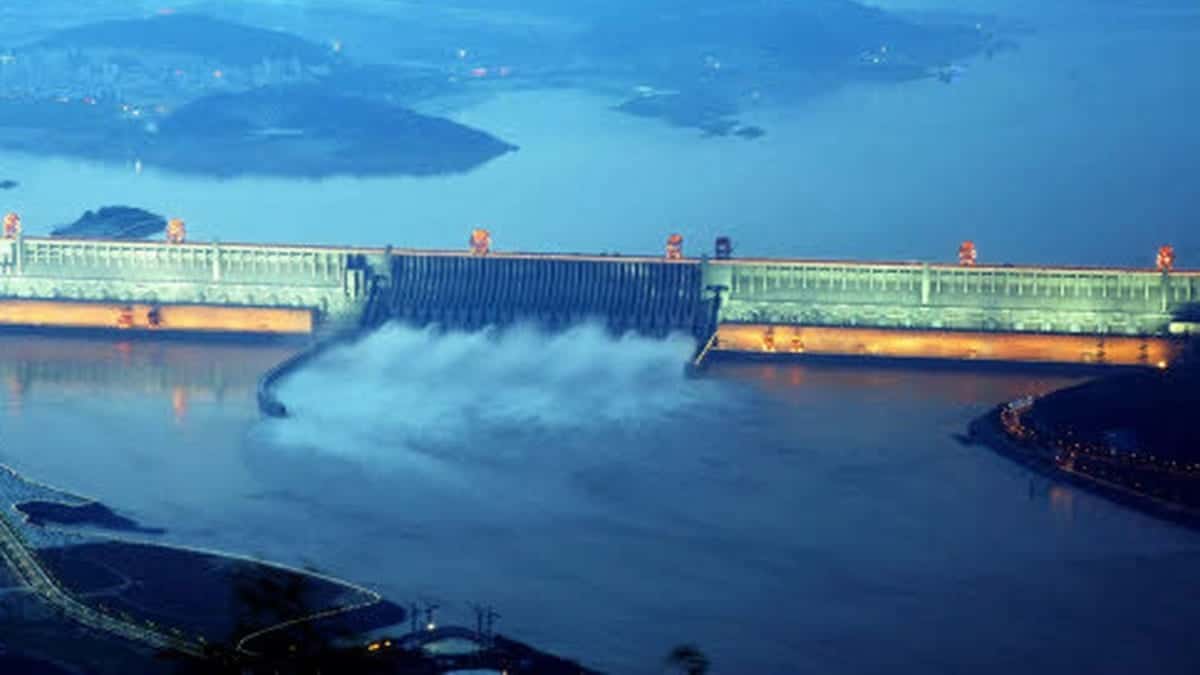
The Three Gorges Dam in China is often hailed as an engineering masterpiece, standing as one of the most impressive feats of modern technology. However, NASA has recently pointed out an unexpected consequence of this monumental project: its vast reservoir could slightly slow down Earth’s rotation. Though the effect is incredibly small, it’s a reminder of how human activity can have a subtle yet far-reaching impact on our planet’s most basic mechanics.
Amazon co-founder MacKenzie Scott has donated over $19 billion to charity in just five years
Diamond batteries powered by nuclear waste promise 28,000 years of clean energy
The Science Behind the Phenomenon
Located on the Yangtze River in China’s Hubei province, the Three Gorges Dam holds a massive 40 cubic kilometers of water—equivalent to about 40 trillion liters. When this enormous amount of water is concentrated in one place, it changes the Earth’s moment of inertia. This principle is something most of us can relate to—think of an ice skater pulling in their arms to spin faster or extending them to slow down.
NASA first discussed this in 2005, after researchers analyzed how large-scale events can impact the Earth’s rotation. They had previously noted that the 2004 Indian Ocean earthquake and tsunami caused measurable changes in Earth’s rotation by shifting tectonic plates. Using the same physics, scientists concluded that the Three Gorges Dam, by redistributing a tremendous amount of water, could shift the Earth’s poles by about two centimeters and add an extra 0.06 microseconds to the length of a day.
A Tiny Change with Big Implications
While this effect is so small that it’s undetectable in daily life, it speaks volumes about the ways in which human infrastructure can affect the Earth on a grand scale. Other factors—natural and man-made—also contribute to fluctuations in the Earth’s rotation. For example, the melting of glaciers leads to water moving from the poles toward the equator, which also contributes to the planet’s gradual slowdown.
Interestingly, even before the Three Gorges Dam was built, scientists had already documented a natural, slow-down of Earth’s rotation, caused by the gravitational pull of the Moon. The dam’s effect, though measurable, simply adds to this ongoing trend.
Could We One Day Adjust Time?
As the Earth’s rotation gradually slows down, there’s been talk among scientists about how this could affect atomic timekeeping. The idea of introducing a “negative leap second” to atomic clocks—removing a second to keep them in sync with the Earth’s rotation—has been discussed. Although this remains a hypothetical scenario, it highlights just how intertwined human progress is with natural planetary systems.
Engineering Marvel or Environmental Concern?
Beyond its influence on the Earth’s rotation, the Three Gorges Dam has sparked environmental and social concerns. While the dam provides hydropower, helps with flood control, and improves navigation, it has also led to the displacement of millions of people and caused disruptions in local ecosystems. Its unintended effect on Earth’s rotation serves as a reminder that no large-scale project exists in isolation from the larger natural world.
NASA’s observation of the Three Gorges Dam’s subtle impact on Earth’s rotation is a fascinating case study. It illustrates how even human-made structures can subtly influence celestial mechanics. Though the effect is minor, it reinforces the need for us to think about the broader, global consequences of infrastructure and environmental changes as we move forward into the future.
NASA warns China could slow Earth’s rotation with one simple move
This dog endured 27 hours of labor and gave birth to a record-breaking number of puppies