
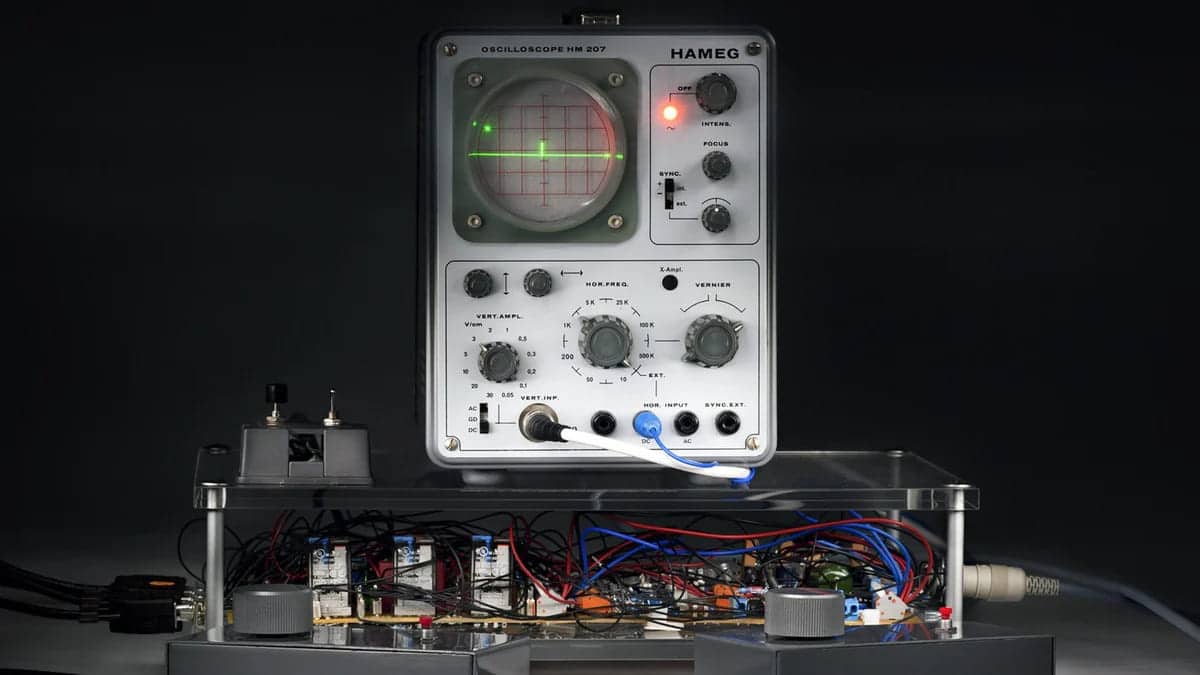
Long before Pong’s pixelated court, William Higinbotham’s “Tennis for Two” in October 1958 pioneered interactive electronic gaming on an oscilloscope.
Amazon co-founder MacKenzie Scott has donated over $19 billion to charity in just five years
Diamond batteries powered by nuclear waste promise 28,000 years of clean energy
The first video game in history
I still remember the thrill of dropping a quarter into the arcade’s glowing cabinet and losing myself in Pong as a kid. Yet, long before Pong’s digital court was etched in our memories, an unassuming physics experiment quietly laid the groundwork for interactive entertainment. On October 18, 1958, at Brookhaven National Laboratory, nuclear physicist William Higinbotham unveiled Tennis for Two—an interactive exhibit built on an oscilloscope¹.
Higinbotham rigged a Donner Model 30 analog computer to simulate a side-view tennis court. Two players gripped custom aluminum controllers, adjusting a rotary knob to set shot angle and pressing a button to “serve” the electron-beam “ball” over a drawn net. According to Brookhaven archives, the exhibit “allowed visitors to grasp complex physics principles through hands-on play,” blending science outreach with friendly competition.
Did you know? Lines formed so quickly that the fragile electronics overheated, prompting Higinbotham to replace parts mid-exhibition².
A genuine milestone
By the following year, Tennis for Two featured gravity simulations for the Moon and Jupiter, a larger display, and refined controls—but after the 1959 public day, it was dismantled and largely forgotten. Its revival came in 1982, when Creative Computing magazine hailed it as “the missing link in gaming history.” Purists note it used analog oscillations rather than video-signal rasterization, distinguishing it from later console and arcade titles.
Earlier experiments, such as Bertie the Brain (1948)—a tic-tac-toe machine in Canada—and the UK’s Nimrod computer (1951), also vie for “first game” status under different definitions. Still, few dispute Tennis for Two’s legacy. As Jacob Aron of IEEE Spectrum observes, “Tennis for Two pioneered interactive entertainment long before silicon chips and joysticks became household staples.” Its brief but brilliant moment on a laboratory oscilloscope reminds us how curiosity and play can spark entire industries.
Sources:
-
Brookhaven National Laboratory. “History: The First Video Game?” https://www.bnl.gov/about/history/firstvideo.php
-
Tennis for Two – Wikipedia. https://en.wikipedia.org/wiki/Tennis_for_Two