
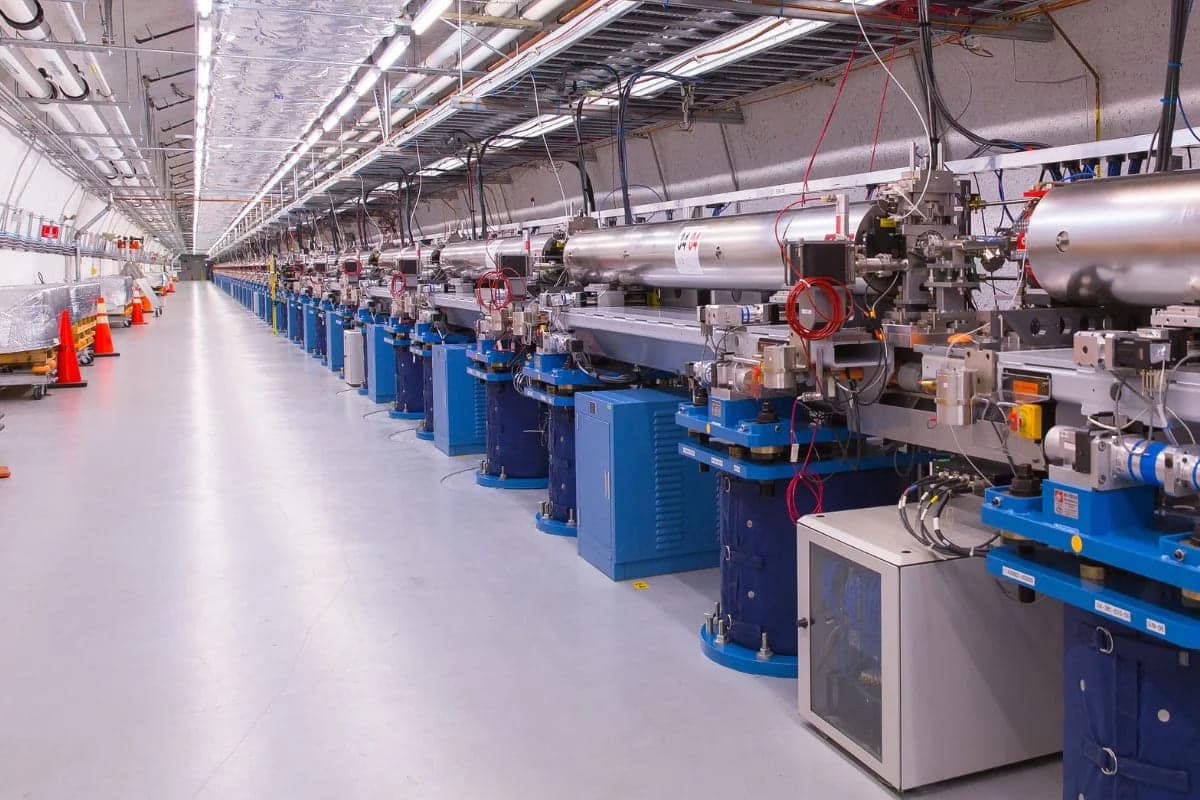
When I first toured a university particle accelerator, the thrum of magnets and the flash of detectors felt like stepping into the future. Now, researchers at SLAC National Accelerator Laboratory have pushed that future even further. In a paper published in Physical Review Letters on February 27, 2025, they report generating an ultrashort (femtosecond-duration) electron beam with a peak current of approximately 0.1 megaampere—five times greater than any previously achieved¹. Claudio Emma, a staff scientist at SLAC’s FACET-II facility and lead author of the study, said they “can steer and shape [the beam] with unprecedented precision,” opening new avenues in quantum chemistry, astrophysics and materials science².
Amazon co-founder MacKenzie Scott has donated over $19 billion to charity in just five years
Diamond batteries powered by nuclear waste promise 28,000 years of clean energy
Did you know? FACET-II delivers electron beams up to 10 GeV of energy along its one-kilometre accelerator complex.
Electron beams vs lasers: matter meets light
At first glance, comparing an electron beam to a laser might seem odd—one hurls particles, the other waves of light. Yet both deliver concentrated energy. A laser uses photons, travelling long distances in air with minimal absorption, to slice through steel or perform eye surgery. By contrast, an electron beam is a stream of charged particles that must operate under high vacuum (~10⁻⁷ Pa) to avoid scattering³. It underpins techniques from electron microscopy—achieving sub-ångström resolution for near-atomic detail⁴—to precision welding in aerospace manufacturing. While lasers dominate many industries, high-current electron beams bring unique particle–matter interactions that pure light cannot match.
Balancing power and beam quality
Pumping up the current of an electron beam usually comes at the cost of coherence. Packing more electrons into an ever-smaller packet leads to intense synchrotron-radiation losses that degrade beam focus. Traditionally, accelerators impart an “energy chirp” (faster electrons at the tail catching the head) and send them through a magnetic chicane—much like staggered runners converging at the finish line. Yet the stronger the compression, the greater the radiation and scattering, blurring that tight pulse.
Laser-driven breakthroughs refine compression
SLAC’s team turned to technology inherited from its Linac Coherent Light Source (LCLS) free-electron laser. By deploying an ultra-precise laser modulator, they sculpted the energy profile of billions of electrons across a sub-micrometre stretch. “A laser allows far more exact energy tweaking than conventional fields,” Emma explained. The challenge? Orchestrating this interaction within the first ten metres of a kilometre-long accelerator, then preserving that modulation without losses—a feat achieved after months of meticulous calibration.
Did you know? LCLS was the world’s first hard X-ray free-electron laser when it achieved first lasing in April 2009⁵.
A game-changing tool for science
With this ultra-powerful, ultrashort pulse, scientists can recreate in the lab phenomena previously confined to distant galaxies. Astrophysicists at FACET-II have already used the beam to mimic plasma filaments found in stellar winds, offering fresh insights into cosmic processes. Meanwhile, material scientists are exploring plasma wakefield acceleration to shrink the next generation of particle colliders from kilometres down to classrooms. Emma and colleagues now aim for attosecond-scale pulses—“like an ultrafast camera,” as Emma puts it—to capture matter’s fastest motions.
Leading electron accelerators worldwide
This breakthrough cements FACET-II’s status at the top of the leaderboard for high-current, ultrashort beams:
-
FACET-II (SLAC, USA) — ultrashort beam, record peak current¹
-
European XFEL (Germany) — up to 17.5 GeV electrons and a 3.4 km undulator for intense X-rays
-
LCLS (SLAC, USA) — high-brightness free-electron laser driving attosecond science⁵
-
AWAKE (CERN, Switzerland) — plasma wakefield acceleration experimental programme
-
Vivitron (IPN Orsay, France) — 25 MV Van de Graaff generator for nuclear physics
As Emma invites at the paper’s close, “If you need an extreme beam, we’ve got you covered. Let’s collaborate!” With this new tool, the scientific world is poised to probe nature’s building blocks in ways we’ve only imagined.
Footnotes :
-
Experimental Generation of Extreme Electron Beams for Advanced Accelerator Applications, Physical Review Letters, https://doi.org/10.1103/PhysRevLett.134.085001
-
SLAC scientists created the most powerful ultrashort electron beam in the world, SLAC National Accelerator Laboratory, https://www6.slac.stanford.edu/news/2025-03-03-slac-scientists-created-most-powerful-ultrashort-electron-beam-world
-
Transmission electron microscopy, Wikipedia, https://en.wikipedia.org/wiki/Transmission_electron_microscopy
-
Cryogenic electron microscopy, Wikipedia, https://en.wikipedia.org/wiki/Cryogenic_electron_microscopy
-
Linac Coherent Light Source, Wikipedia, https://en.wikipedia.org/wiki/LCLS
NASA warns China could slow Earth’s rotation with one simple move
This dog endured 27 hours of labor and gave birth to a record-breaking number of puppies