

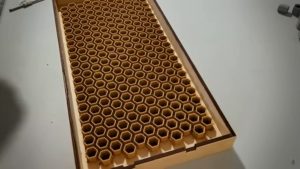
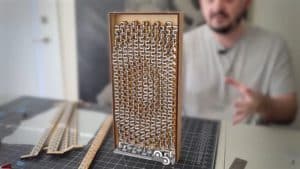
When most gamers talk about upgrading their rig, they mean adding more RAM or finally splurging on that RTX graphics card. But for one inventive builder with a passion for 3D printing, electronics, and a flair for the artistic, “upgrade” took on a whole new meaning. In just eight weeks, this creator transformed an ordinary PC case into a mesmerizing kinetic sculpture—complete with 885 custom parts and 12 motors working in perfect sync.
Amazon co-founder MacKenzie Scott has donated over $19 billion to charity in just five years
Diamond batteries powered by nuclear waste promise 28,000 years of clean energy
From Simple Movement to Mechanical Art
The project started with a modest goal: introduce actual movement—not just flashy LEDs or spinning fans—to the front of a PC case. Picture a single hexagonal disc, 3D printed in transparent plastic, spinning gently as it catches the light from inside the tower. It was controlled by a basic Arduino Uno setup—quick and dirty, but enough to spark something bigger.
That initial module was charming, like the first time you get an LED to blink in a school electronics kit. But it wasn’t enough. There was no interaction, no rhythm—just a static spin. So the builder took things up a notch. They imagined an entire moving façade, built from multiple hexagons arranged in precise symmetry, each one rotating independently.
Design Challenges—and a Shift in Strategy
Early prototypes tried to link all the hexagons mechanically, like gears in a watch. But friction, flexing wood panels, and overloaded motors quickly showed the limitations of that approach. When multiple modules spun at once, the whole thing jammed up or stalled. It was like trying to ride a bike with all the brakes half-pressed.
So the strategy changed: instead of connecting everything, each hexagon would become its own little unit—independently motorized, and easier to fine-tune. Out came Fusion 360, the 3D design software, and with it, a full redesign from the ground up.
885 Custom Parts and Micro-Precision Synchronization
The final version is nothing short of an engineering flex. Each group of four hexagons is mounted vertically and driven by a dedicated NEMA 17 stepper motor—the kind often used in 3D printers. In total, there are 12 motors, each controlling a column of movement. All the support brackets, gears, guides, and mounts were printed at home using PLA plastic—some parts taking over 10 hours to produce.
Assembly wasn’t just about putting things together—it involved repeated testing, breakdowns, realignments, and tweaking code by hand. The Arduino codebase evolved into a structured masterpiece, letting each motor rotate independently, even creating wave-like ripple effects by desynchronizing movements.
NASA warns China could slow Earth’s rotation with one simple move
This dog endured 27 hours of labor and gave birth to a record-breaking number of puppies
The result? A living, breathing PC case that looks like it belongs in a museum of kinetic art.
The Downside of Motion: Noise and Vibration
Of course, all those moving parts came with a catch: vibration and noise. The motors’ hum echoed through the structure, turning what should have been a zen display into something closer to a coffee grinder. To fix it, the builder got clever—adding silent blocks under the motors and cushioning key joints with felt dampeners. It’s still not whisper-quiet, but the system is now tolerable during gaming sessions, even if your PC tower gently hums like it’s thinking too hard.
No Practical Use, All Visual Wonder
Functionally, this kinetic façade doesn’t cool the system, read data, or affect performance. It doesn’t need to. It’s purely aesthetic, reacting the moment the PC boots and moving until the user shuts it down. Think of it as a cross between extreme PC modding and kinetic sculpture—a piece of interactive art that makes the machine feel alive.
Whether you’re into PC building, motion design, or just love seeing what can happen when creativity meets coding, this project is a testament to what one person can achieve with a vision, a soldering iron, and a 3D printer. And maybe a bit of obsession.