
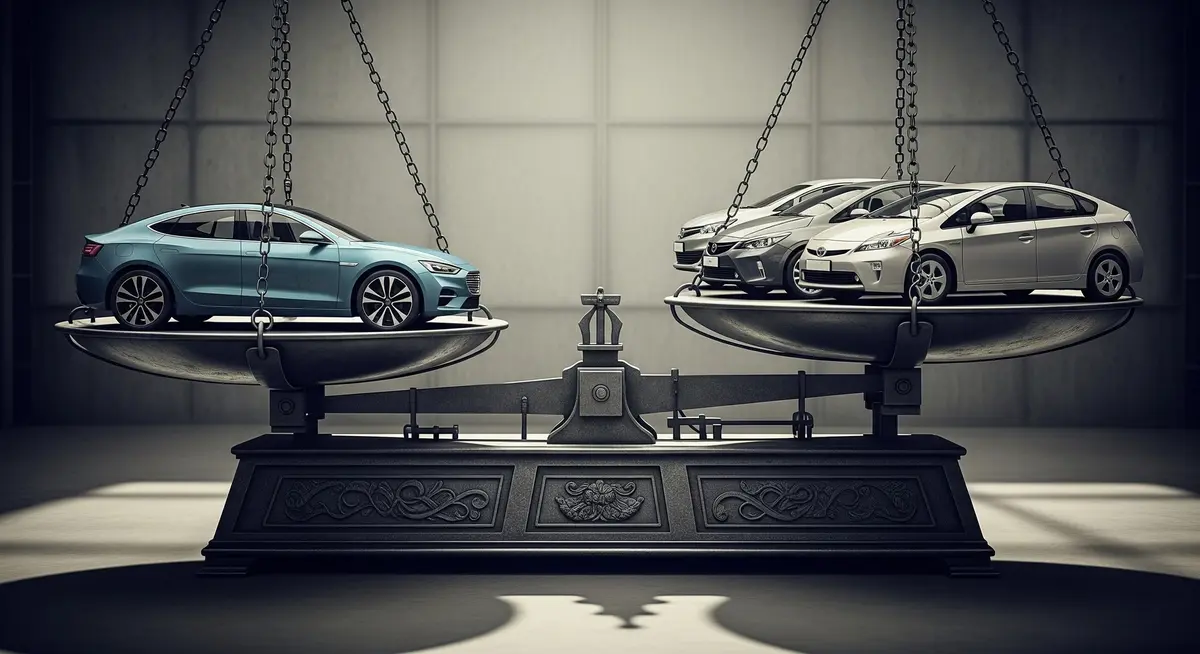
Toyota’s President Claims an Electric Vehicle Pollutes as Much as Three Hybrids, Reigniting the Debate on Real Emissions from Different Engine Types
Amazon co-founder MacKenzie Scott has donated over $19 billion to charity in just five years
Diamond batteries powered by nuclear waste promise 28,000 years of clean energy
Akio Toyoda’s Weighty Words
In a widely circulated interview, Akio Toyoda, the president of Toyota, stated that 9 million electric vehicles would emit as much as 27 million hybrids. In other words, one electric vehicle would pollute as much as three hybrids. This statement, made in the context of Japan’s energy landscape, quickly sparked global reconsideration of the environmental benefits of electric cars. This has cast doubt in the minds of some consumers and delighted critics of electric vehicles, who quickly spread the word.
A More Complex Comparison Than It Seems
Scientific studies on the subject are clear: electric cars, despite a higher initial carbon cost due to battery production, become less polluting than hybrids over time. According to the Argonne National Laboratory, an electric vehicle “pays back” its carbon footprint from production after about 19,500 kilometers. In the most pessimistic scenarios, this threshold may be as high as 28,000 kilometers. However, most drivers far exceed these distances within a few years (I just passed 90,000 kilometers on my Zoe, and I plan to keep it for another three years, until the end of my lease).
It All Depends on the Energy Mix… But Not So Much
Toyoda’s main argument hinges on the fact that Japanese electricity is still largely generated from fossil fuels. In the United States, nearly 43% of electricity came from decarbonized sources by the end of 2024. Even in states still heavily reliant on coal, electric models like the Tesla Model Y generally emit less than a plug-in hybrid like the Prius, according to calculations by the Department of Energy.
In France, by 2024, 95% of electricity was produced from decarbonized sources, namely nuclear and renewable energies (hydro, wind, solar, biomass). This figure ranks France among the countries with the least carbon-intensive electricity in the world. Needless to say, the numbers just don’t add up, Akio.
Technologies in Transition
It’s important to note that hybrids and PHEVs are not enemies of electrification. They are valid transitional solutions, especially for drivers who cannot easily recharge at home. But as batteries become cleaner to produce, recycling becomes more organized, and power grids decarbonize, fully electric cars are becoming more environmentally competitive.
What’s the Verdict?
Toyoda’s comments may be understandable in a specific energy context, but they do not take into account the rapid evolution of technologies and infrastructures. If the goal is a massive reduction in emissions, current data show that electric vehicles remain the most effective solution in the long term, ahead of hybrids. Especially considering the number of hybrids in circulation that are never recharged (particularly in corporate fleets). In such cases, owning a hybrid is simply an ecological absurdity.
Would you dare to share your thoughts on these issues? Let’s go for it: comments are open! You can also react on our Facebook page.