
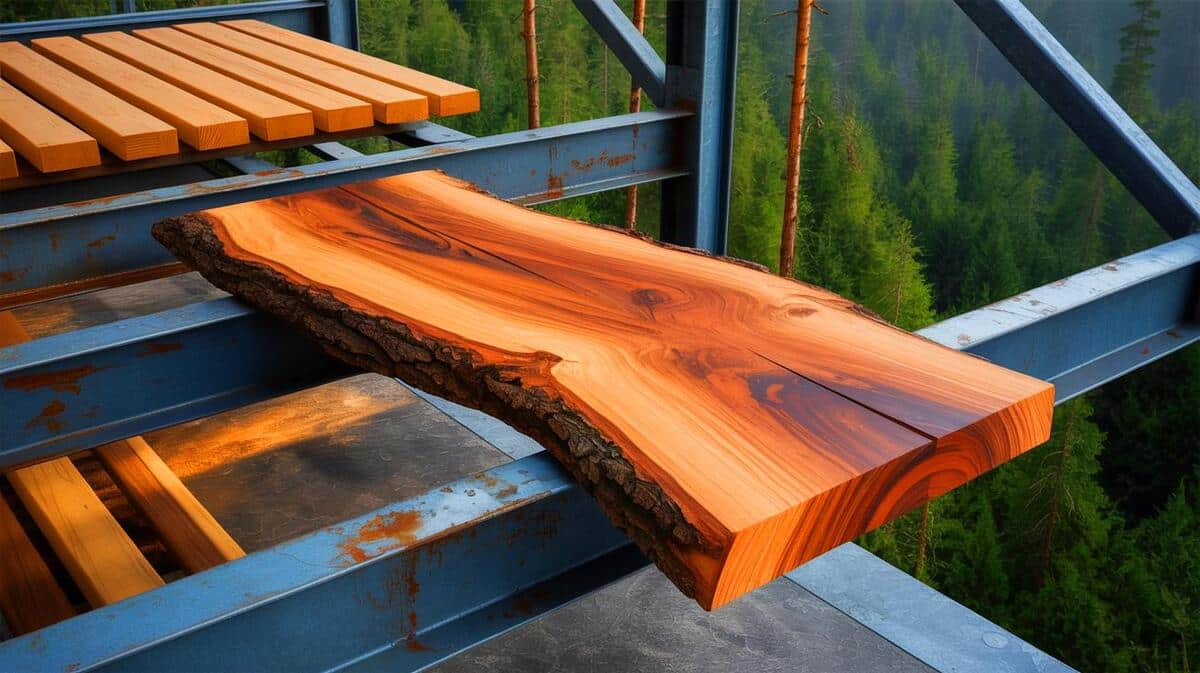
Imagine a world where skyscrapers are built with the warmth of wood, rather than the cold, rigid steel that dominates our cityscapes today. This isn’t some futuristic dream—it’s becoming a reality thanks to a groundbreaking material known as Superwood. Created by InventWood, a startup from Maryland, Superwood is pushing the boundaries of what we thought was possible with natural materials. Stronger than steel and lighter than aluminum, this new “biogenic composite” is redefining the future of construction.
Amazon co-founder MacKenzie Scott has donated over $19 billion to charity in just five years
Diamond batteries powered by nuclear waste promise 28,000 years of clean energy
Wood that outperforms steel
I had the chance to witness this revolutionary material firsthand, and it left me genuinely impressed. The first time I held a piece of Superwood, it was denser than any piece of timber I had ever felt. But here’s the kicker—it outperformed steel in a stress test, despite being significantly lighter. The process behind it is both innovative and deceptively simple. Superwood is made by removing lignin, the substance that gives wood its rigidity, and then compressing the remaining cellulose fibers under high heat and pressure. The result? A material with a strength-to-weight ratio that matches structural steel’s (400 MPa) but weighs less than aluminum, which comes in at 2.7 g/cm³.
Alex Lau, the CEO of InventWood, has a simple way of describing their achievement: “We’re unlocking wood’s hidden potential.” With over $50 million in funding, including backing from the U.S. Department of Energy and the Department of Defense, this material is positioned to transform how we think about construction and engineering.
Did you know? Cellulose fibers—the core of Superwood—are among nature’s strongest polymers. When these fibers are densely packed and aligned, they offer tensile strengths that can reach up to 3 GPa, making them even tougher than steel in some cases¹.
Sustainable, eco-friendly, and revolutionary
Aside from its impressive strength, Superwood offers an environmentally friendly alternative to traditional building materials. As someone who switched from a bulky metal laptop stand to one crafted from engineered wood, I can personally appreciate the benefits of using renewable resources in everyday life. What makes Superwood even more exciting is that its production relies on locally sourced timber, reducing transportation emissions, and its manufacturing process avoids the carbon-intensive processes involved in smelting and casting metals.
Environmental experts are already calling this an “extraordinary advancement.” Paul Hawken, a well-known environmental entrepreneur, points out that Superwood can cut the embodied carbon of building designs by up to 70% when compared to those dominated by steel². What’s more, InventWood promises that every plank of Superwood meets strict eco-friendly standards, showing that performance and sustainability can go hand in hand.
The science behind the material
What makes Superwood truly magical is the science that happens at the molecular level. By stripping out lignin—the component in wood that makes it stiff—and then applying high pressure and heat to the remaining cellulose fibers, researchers have created a material that is not only stronger but more durable as well. This process makes Superwood resistant to the usual problems that affect timber, like fire, moisture, mold, and insects. The end result? A material that keeps the aesthetic appeal of wood while enhancing its mechanical properties to make it even more versatile than before.
NASA warns China could slow Earth’s rotation with one simple move
This dog endured 27 hours of labor and gave birth to a record-breaking number of puppies
And to maintain its natural moisture balance, Superwood is treated with a bio-based sealant. This sealant allows vapor to diffuse through the wood, while blocking liquid water—helping preserve the material’s integrity even in challenging environments.
The future of construction: Could wood replace steel?
As I walked past a Superwood-framed storefront recently, I overheard contractors talking excitedly about its potential applications—from high-rise buildings to everyday furniture. It seems the world is finally waking up to the possibilities of green building materials, and InventWood is perfectly poised to take advantage of the growing demand for sustainable solutions.
That said, there are challenges ahead. Building codes will need to be updated to accommodate this innovative material, and creating sustainable supply chains will be crucial. But with robust funding and a clear vision, Superwood is ready to disrupt the construction industry. Could this be the moment when renewable materials finally begin to rival steel and aluminum in the world of engineering and construction? If the success of current prototypes is anything to go by, the future of building could very well be more wooden than metallic.
One thing is for sure: the days of exclusively using steel and aluminum in skyscrapers may soon be over. Thanks to innovations like Superwood, the future is looking brighter—and greener.
Sources:
-
“Superwood: A Sustainable Advancement in Building Materials.”. https://www.superwood.dk/app/uploads/2024/05/Superwood-Sustainability-report-2022-23.pdf
-
“Innovative Biogenic Materials: The Superwood Technology.” https://finance.yahoo.com/news/revolutionary-superwood-technology-named-fast-155500342.html
-
InventWood. “The Science Behind Superwood.” https://www.inventwood.com/technology