
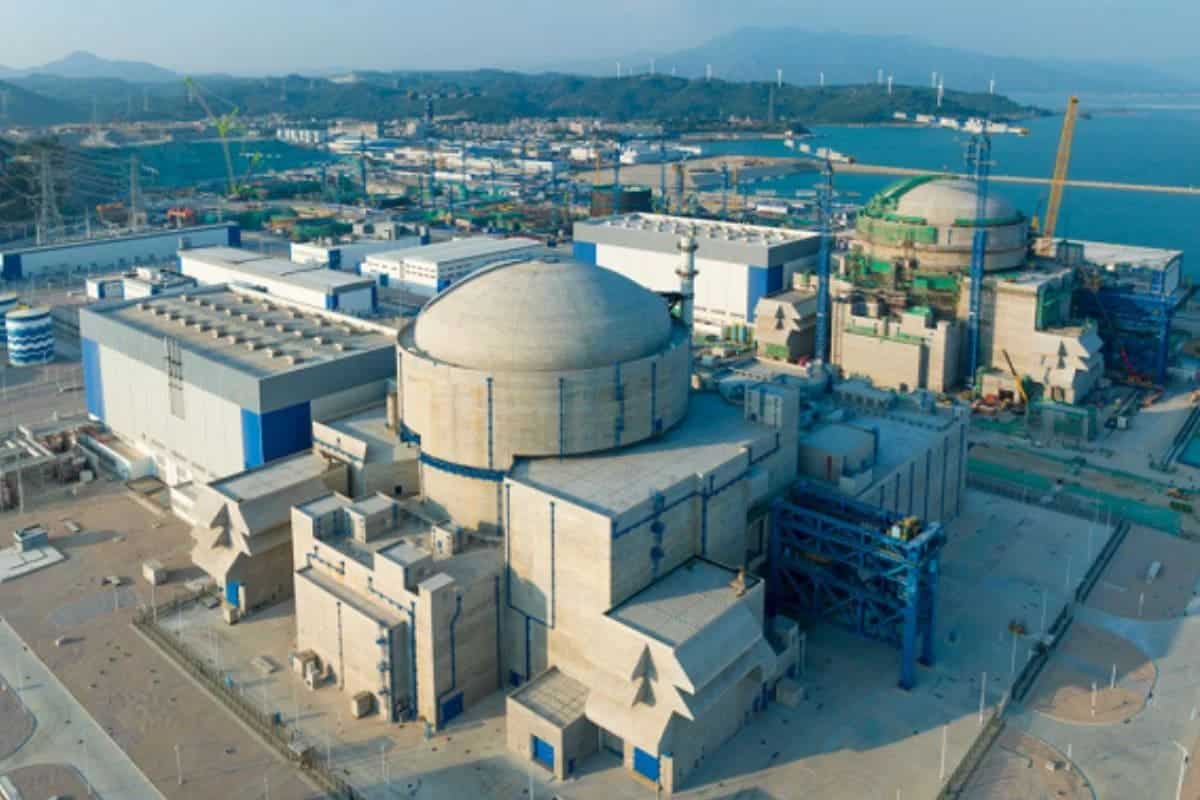
In recent months, China has quietly made strides in its nuclear energy program that are capturing global attention. As someone who once toured a French nuclear facility in Normandy—marveling at the precision of its reactors—I never imagined that a project on the other side of the world could close the gap so quickly. Now, with the commissioning of Zhangzhou’s second reactor, Paris must contend with a shifting balance in global nuclear capacity, challenging France’s traditional leadership.
Amazon co-founder MacKenzie Scott has donated over $19 billion to charity in just five years
Diamond batteries powered by nuclear waste promise 28,000 years of clean energy
The second Hualong-1 reactor nearly ready at Zhangzhou
Nestled along China’s southeast coast, the Zhangzhou nuclear power plant is poised to become one of the world’s most formidable complexes. In April 2025, engineers successfully completed the crucial “hot functional tests” for the second reactor—a vital rehearsal that runs heated water through the system to verify safety and thermal performance, but without any radioactive fuel present. According to the International Atomic Energy Agency (IAEA), such tests are the final step before fuel loading, ensuring that all cooling and control systems operate exactly as intended. Once uranium is loaded later this year, this reactor will join its sibling unit, which has already been feeding electricity into the grid since January 2025.
I remember chatting with a colleague at the World Nuclear Association (WNA) conference last year about how often these critical tests can become bottlenecks, sometimes delaying a reactor’s startup by months. Yet Zhangzhou’s engineers completed theirs on schedule, underscoring their methodical approach—one that promises a swift path to full operation and a looming head-to-head with French nuclear giants.
Hualong-1: China’s homegrown flagship
Designed, developed, and built entirely within China, the Hualong-1 reactor represents a landmark achievement for the China National Nuclear Corporation (CNNC). Drawing on decades of experience, CNNC fused elements from its ACP1000 and CGN’s ACPR1000+ designs to create a three-loop pressurized water reactor that meets stringent international safety standards. Each unit delivers 1,000 MW (1 GW) of electrical output—enough to power around one million homes annually, according to the WNA.
What strikes me as particularly impressive is the reactor’s independence from foreign technology. During a 2024 tour of a UK reactor site, one of the technicians explained how Western plants often rely on imported steam generators or control systems. In contrast, Hualong-1’s key components—from the pressure vessel to the digital control modules—are manufactured domestically. This self-reliance not only bolsters China’s national energy security but also positions the reactor as an attractive export, with projects already underway in Pakistan and discussions open with several European and African nations.
Zhangzhou: a nuclear complex with grand ambitions
When complete, Zhangzhou will host six Hualong-1 reactors totaling 7.2 GW—second in size only to Japan’s Kashiwazaki-Kariwa facility. The first unit began commercial operation in January 2025. The second is slated to connect by year-end, while construction of the remaining three is progressing at a brisk pace. Collectively, these reactors will generate more than 60 TWh of electricity per year, estimates from the World Nuclear Association suggest. That output can replace over 3 million tonnes of coal annually and avoid roughly 8.16 million tonnes of CO₂ emissions—equivalent to planting 70 million trees each year.
At a renewable energy summit in Beijing last November, a Chinese engineer proudly displayed a slide showing Zhangzhou’s footprint compared to France’s Gravelines and Paluel plants—each totalling around 5.3 GW. Seeing six massive containment domes rising from farmland reminded me of the sense of scale I felt walking among the cooling towers of France’s Cattenom plant. But whereas Cattenom was conceived in the 1970s, Zhangzhou’s state-of-the-art design benefits from decades of refined nuclear research.
China’s nuclear gamble
Currently, nuclear energy supplies just 5 % of China’s electricity. Yet Beijing aims to double that share to 10 % by 2035 and reach 18 % by 2060, complementing an aggressive phase-out of coal and other fossil fuels. At the heart of this plan lies the Hualong-1, intended to be the workhorse of China’s low-carbon push. Beyond Zhangzhou, two additional Hualong-1 units are under construction in Pakistan, and several more are in initial planning stages across Europe, Latin America, and Africa. By exporting this design, China hopes to outpace long-established nuclear powers like Russia, France, and the United States.
NASA warns China could slow Earth’s rotation with one simple move
This dog endured 27 hours of labor and gave birth to a record-breaking number of puppies
I recall a discussion with a French nuclear regulator who cautioned that delivering a reactor on time and on budget is a rare victory in this sector. Yet Zhangzhou’s first two units were each built in under six years—an achievement that surprised many in the industry. In comparison, France’s Flamanville 3, which began in 2007, only started feeding power into the grid in June 2024. As Zhangzhou accelerates ahead, Paris must reconcile its own timeline challenges with an increasingly assertive competitor.
A meticulous, science-driven approach
The rapid pace of Zhangzhou’s construction did not happen by accident. CNNC engineers collaborated closely with top Chinese research institutes to refine every aspect of Hualong-1’s design—optimizing cooling systems, strengthening safety protocols, and standardizing manufacturing processes. This parallel coupling of scientific innovation and large-scale industry mirrors China’s broader strategy for high-technology projects: iterate quickly, scale aggressively.
During a site visit to the China Academy of Launch Vehicle Technology (CALT) last year, I saw similar teamwork in action: materials scientists and nuclear engineers huddled over digital models, simulating thermal stresses at extreme temperatures. The result is a reactor that meets the International Atomic Energy Agency’s stringent requirements for redundancy, seismic resilience, and passive safety. Such comprehensive testing and collaboration helped reduce typical delays and cost overruns, a feat rarely matched elsewhere.
The global nuclear leaderboard reshaped
Today, the world’s top nuclear sites rank as follows: Japan’s Kashiwazaki-Kariwa leads with 8 212 MW, Canada’s Bruce stands at 6 430 MW, and Ukraine’s Zaporizhzhia clocks in at 5 700 MW. France’s Gravelines (5 460 MW), Paluel (5 320 MW), and Cattenom (5 200 MW) follow closely. Once Zhangzhou’s six units come online, its 7 200 MW capacity will vault it into the number-two spot globally. That ascension signals more than just national pride—it carries significant geopolitical weight.
For France, whose nuclear fleet supplies roughly 70 % of its electricity (according to the European Nuclear Society), the emergence of a rival this size presents both a wake-up call and an opportunity. On one hand, Chinese reactors will command new markets, potentially undercutting French exports with competitive pricing and shorter build times. On the other, this challenge could spur fresh innovation in Europe—prompting engineers to invest further in advanced reactor designs, small modular reactors (SMRs), and next-generation fuel technologies.
As I boarded a TGV from Paris to Dijon earlier this year, I leafed through a report predicting that by 2030, China could outstrip the combined nuclear capacity of all G7 countries except the United States. While France retains expertise honed over half a century, Zhangzhou’s rapid rise underlines a fundamental shift: nuclear leadership is no longer guaranteed. If Paris hopes to maintain its influential role, it must balance safeguarding its domestic fleet with reinvesting in cutting-edge research—because in the race for nuclear supremacy, the finish line is always moving.