
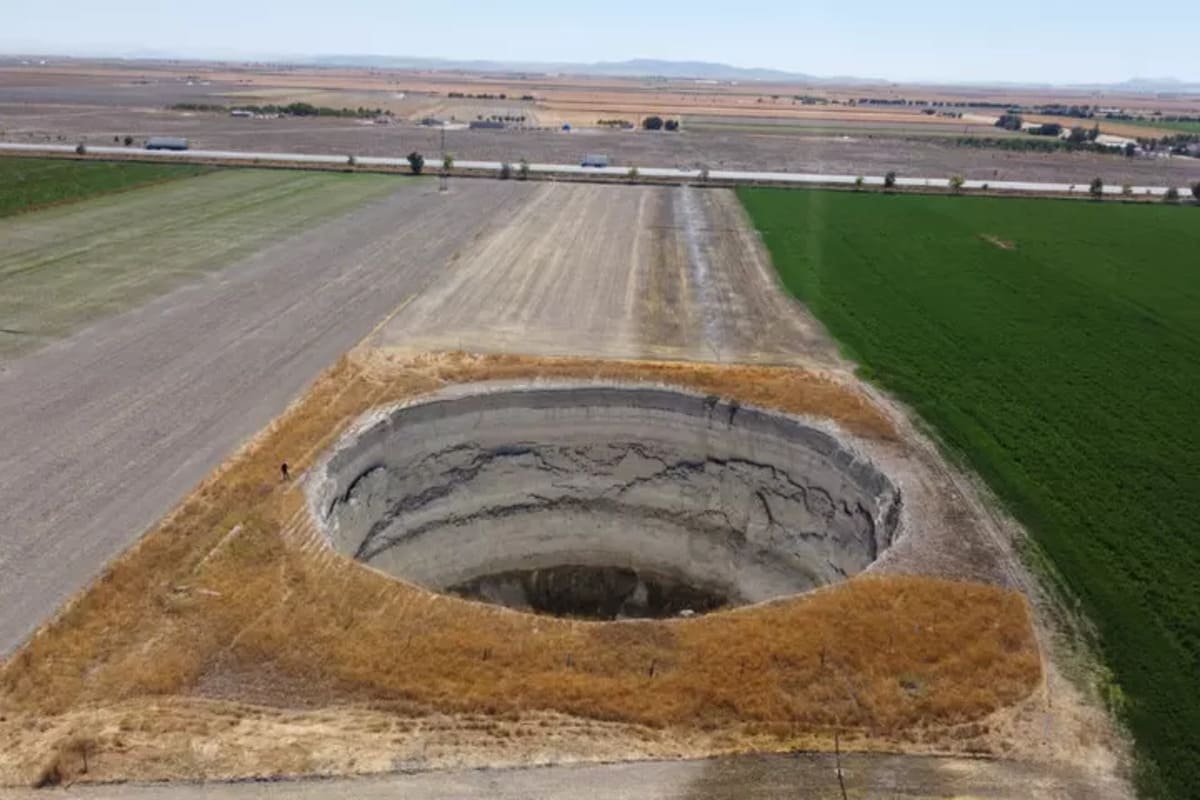
Last spring, I visited a family friend’s farm on the outskirts of Konya, where endless fields of wheat stretched to the horizon. As we chatted about the region’s booming cereal production, she pointed to a yawning hole near her barn and whispered, “That wasn’t here last year.” In central Anatolia, sinkholes—known locally as “dolines”—are appearing at an alarming rate, and the culprit is no mystery: industrial agriculture is draining underground water reserves faster than the earth can replenish them.
Amazon co-founder MacKenzie Scott has donated over $19 billion to charity in just five years
Diamond batteries powered by nuclear waste promise 28,000 years of clean energy
Gigantic sinkholes in the heart of Anatolia
On September 14, a farmer in Konya Karapınar awoke to find a cavern 50 meters wide and 40 meters deep in one of his fields. This is more than just an isolated incident: the Konya Technical University’s Doline Research Center counted 2,550 of these chasms in 2021, up from 299 in 2017. Those figures are staggering, but they don’t tell the whole story. Naturally, dolines form over karstic terrain as rainwater dissolves limestone, creating underground voids. Over time, the ground above may collapse under its own weight. Yet in recent years, over-pumping of groundwater for irrigation has accelerated the process, transforming a slow geological phenomenon into an urgent crisis.
Professor Fetullah Arik, head of the Geological Engineering Department at Konya Technical University, noted that “in the 1960s, as farmers ramped up intensive cultivation, they started drilling ever-deeper wells.” By the 1980s, water tables began to drop noticeably; small declines were ignored at first. But after 2000, observers recorded annual drops of 1–2 meters—and more recently, some monitoring wells have plunged over 20 meters in a single year. It’s a stark illustration of how human activity can outpace nature’s ability to restore equilibrium.
The Konya Plain of central Anatolia is plagued by sinkholes. This is an impressively big and deep sinkhole in Konya, Turkey
[read more: https://t.co/eTR4liXswV] [📹 https://t.co/qqmsxl21R8]https://t.co/5jBZGQngsX— Massimo (@Rainmaker1973) April 27, 2023
Industrial farming and over-pumping
Konya Karapınar, often called Turkey’s breadbasket, allocates nearly 90% of its water for crop irrigation. According to a 2014 WWF report, roughly half of that water comes from underground aquifers. “Sugar beets, corn, alfalfa, and sunflowers demand water year-round,” explains Arik. “With recent deficits in winter and spring rainfall, even wheat and barley need irrigation.” As a result, demand for groundwater has skyrocketed, leading to a proliferation of illegal wells. Officially, about 35,000 wells are registered in the region, but local authorities estimate that there are over 100,000 unauthorized boreholes covertly tapping the aquifers.
One afternoon, while sharing tea with a neighbor whose family has farmed the same plot for generations, I watched him gesture toward a newly drilled pump and admit, “We know it’s wrong, but without that extra water, last year’s crops would have failed.” His words encapsulate the dilemma: farmers feel pressured to secure yields, even at the expense of sustainability.
Consequences for communities and infrastructure
The consequences of these ever-expanding craters are far-reaching. Beyond swallowing farmland, dolines damage homes, roads, and utilities. Arik recounts how, in January of last year, a family of five was forced to evacuate when a sinkhole opened mere meters from their house. “Thankfully, no one was hurt,” he says, “but the fear remains.” In another case, a local mosque had to close after part of its foundation collapsed into a newly formed cavity.
These collapses also threaten essential infrastructure: highways, power lines, water pipes, and sewer systems can suddenly lose support from the ground below. Just last year, a rural stretch of road buckled under the weight of an empty truck when a hidden void gave way. Repair crews spent weeks stabilizing the site, while locals detoured dozens of kilometers to reach the nearest town.
NASA warns China could slow Earth’s rotation with one simple move
This dog endured 27 hours of labor and gave birth to a record-breaking number of puppies
A #sinkhole with a diameter of 37 meters and a depth of 12 meters was formed in #Konya
A new sinkhole had formed in #Karapınar yesterday.#Turkey #turkeyearthquake2023 #TurkeyQuake #earthquake #deprem #Wonder pic.twitter.com/RjPidnTvib— Chaudhary Parvez (@ChaudharyParvez) February 25, 2023
A global reckoning with water use
Turkey is not alone in this struggle. Similar sinkholes have appeared in central Australia due to abandoned mines, and in Israel, sand quarrying has unleashed subterranean voids. In Florida, excessive groundwater extraction has caused dramatic land subsidence, forcing homeowners to watch as their backyards turned into miniature craters. These examples prompt a broader question: how will we adapt our water management practices to prevent further land collapse?
Local authorities are experimenting with restrictions on new well drilling and stricter enforcement of permit requirements through the State Hydraulic Works. Yet without a comprehensive shift toward water-efficient irrigation—such as drip systems—or a return to crop rotations that demand less water, the land will continue to yield more than just grain; it will yield gaping holes.
As I drove back through the endless wheat fields, passing yet another gaping pit where the earth had given way, I couldn’t shake the image of that terrified family. Their story, and countless others like it, stand as a reminder: when we treat water as an infinite resource, the ground beneath our feet can betray us.